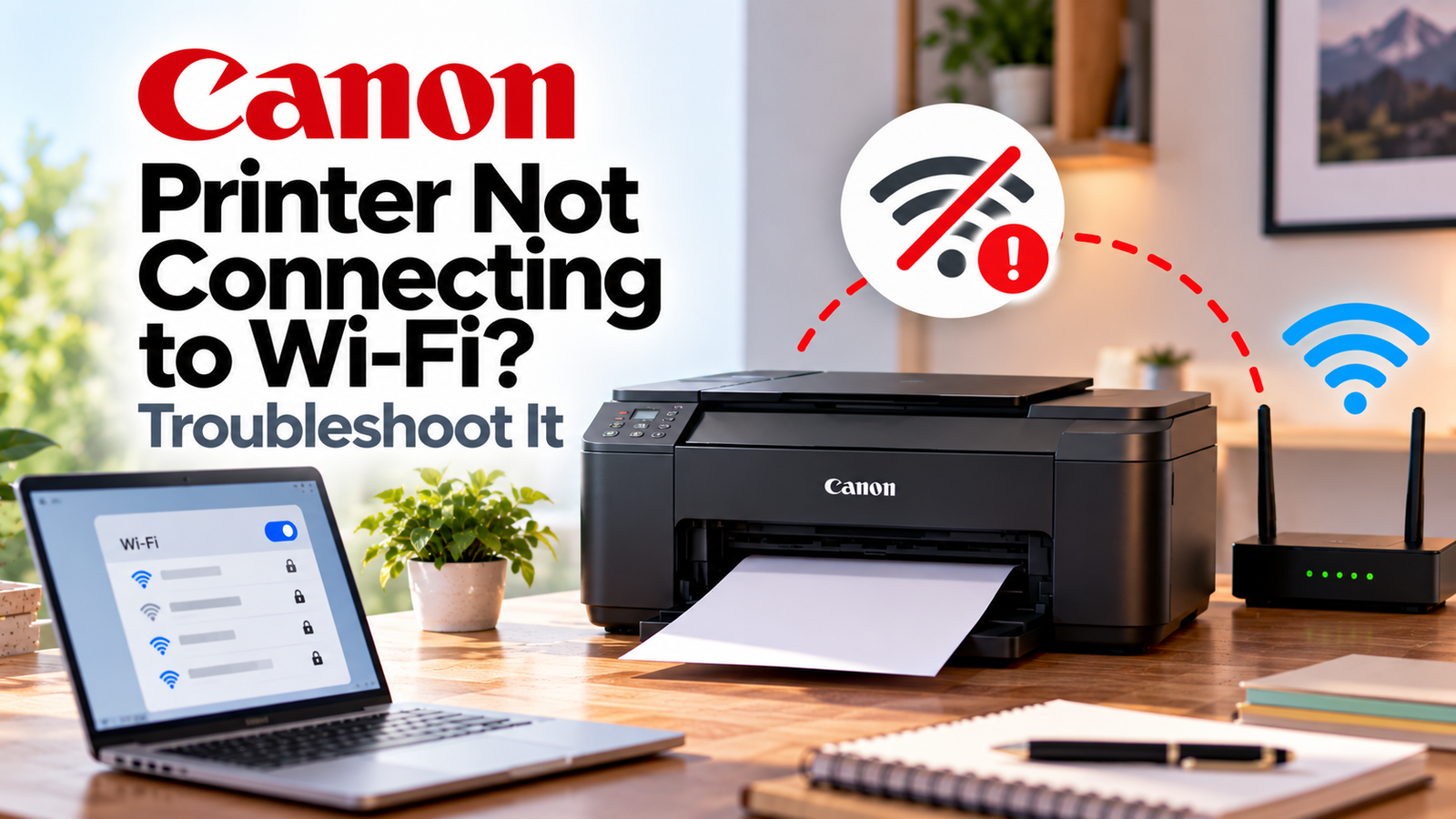
Canon Printer Not Connecting to Wi-Fi? Troubleshoot the Connection
A Canon printer not connecting to Wi-Fi can be caused by an incorrect network password, a changed router, a weak wireless signal, incorrect printer network settings, or a problem preventing the printer and computer from communicating. In some cases, the printer connects to Wi-Fi successfully but still cannot be found by the computer.
The first thing to determine is whether the printer cannot connect to the wireless network at all or whether it is already connected but your computer cannot detect it. Those are different problems and need different troubleshooting steps.
Use the diagnosis table below to identify where the problem is before repeatedly trying to reconnect the printer.
Quick Diagnosis: Start Here
| What you’re seeing | Start here |
|---|---|
| Your Canon printer cannot see your Wi-Fi network | Go to Fix 1 |
| The printer sees your Wi-Fi but refuses to connect | Go to Fix 2 |
| You recently changed your Wi-Fi name, password or router | Go to Fix 3 |
| The printer says it is connected, but your computer cannot find it | Go to Fix 4 |
| The printer is far from the router or has a weak connection | Go to Fix 5 |
| The printer connects but keeps disappearing from the network | Go to Fix 6 |
| Firewall or security software may be blocking the printer | Go to Fix 7 |
| The printer and computer are on Wi-Fi but cannot communicate | Go to Fix 8 |
| Wireless setup keeps failing | Go to Fix 9 |
| You have tried everything and the network configuration may be corrupted | Go to Fix 10 |
Why Is My Canon Printer Not Connecting to Wi-Fi?
A wireless Canon printer has to complete two separate jobs before wireless printing works properly.
First, the printer must establish a connection with your wireless router using the correct network name and password. Then your computer or phone must be able to communicate with the printer over that network.
That distinction matters.
If the printer cannot even see your Wi-Fi network, changing printer settings on your computer will not solve the problem. If the printer is already connected to Wi-Fi but Windows or macOS cannot find it, the problem may instead involve network communication, firewall settings, printer discovery or the printer’s network configuration.
Canon’s own troubleshooting guidance recommends checking the wireless connection, the connection between the printer and router, firewall/security software, and router settings when a printer cannot be detected on a network.
Work through the fixes below in order, or use the Quick Diagnosis table to jump directly to the situation that matches your problem.
Fix 1: Check Whether the Printer Can See Your Wi-Fi Network
Start with the printer itself.
Open the printer’s wireless or network setup screen and look for available Wi-Fi networks. The exact menu names differ between Canon models, but you may see options such as:
- Wireless LAN setup
- Wi-Fi setup
- WLAN setup
- Network settings
- LAN settings
Look for your home Wi-Fi network in the list.
If your Wi-Fi network appears
The printer can see the router, so the problem is likely to be the network credentials or the connection process. Continue with Fix 2.
If your Wi-Fi network does not appear
Check the router first.
Make sure:
- The router is switched on.
- Other devices can see the Wi-Fi network.
- The printer is within reasonable range of the router.
- You selected the correct wireless setup option on the printer.
- The Wi-Fi network is actually being broadcast.
If your phone or laptop also cannot see the Wi-Fi network, the problem is probably with the router or wireless network rather than the Canon printer.
If other devices can see the network but the printer cannot, move the printer closer to the router temporarily and try the wireless setup again.
Fix 2: Check the Wi-Fi Password and Network Name
If your Canon printer can see your Wi-Fi network but will not connect to it, check the network credentials carefully.
The Wi-Fi password is case-sensitive. A single incorrect character can prevent the printer from connecting.
Check:
- Uppercase and lowercase letters
- Numbers
- Special characters
- Spaces
- Similar-looking characters
- The exact Wi-Fi network name you selected
This becomes particularly important if you have several networks with similar names, such as a main network and a guest network.
If your printer has a touchscreen or on-screen keyboard, carefully review the password before confirming it.
Don’t assume that the printer is using the latest password. If you changed your Wi-Fi password recently, the printer may still have the old credentials saved.
Canon’s wireless setup instructions specifically note that the network password is case-sensitive on supported models.
Fix 3: Reconnect the Printer After a Wi-Fi Change
Think about what happened immediately before the Canon printer stopped connecting.
Did you:
- Change your Wi-Fi password?
- Change your Wi-Fi network name?
- Replace your router?
- Reset your router?
- Switch internet providers?
- Install a new mesh Wi-Fi system?
- Move the printer to another location?
If so, the printer may still be configured for the previous network.
A computer being connected to your new Wi-Fi does not automatically reconnect the printer. The printer itself needs to be configured for the current wireless network.
Open the printer’s wireless setup and select your current Wi-Fi network.
Enter the current password carefully and complete the setup.
If you replaced your router, don’t rely on the old printer configuration even if the new router uses a similar network name. Confirm that the printer is actually connected to the intended network.
Once the printer reports a successful wireless connection, try printing again.
Fix 4: Check Whether the Printer Is Connected but Undetected
This is one of the most important distinctions when troubleshooting Canon Wi-Fi problems.
Your printer may already be connected to Wi-Fi while your computer still says that it cannot find the printer.
Look at the printer’s wireless status first.
If the printer reports that its wireless connection is active, check whether:
- Your computer is connected to the expected network.
- The printer and computer are on the same network environment.
- You recently changed routers or network settings.
- An older Canon printer installation is still being used.
- You have multiple entries for the same printer.
Canon’s network troubleshooting guidance specifically recommends checking the printer’s WLAN connection and network settings when the printer cannot be detected.
If the printer is connected but the computer cannot find it, don’t keep entering the Wi-Fi password. The next steps should focus on network communication, firewall settings and printer discovery.
Fix 5: Test the Printer Closer to the Router
If the printer is a long distance from the router, wireless signal strength can affect setup and stability.
This is especially worth checking if:
- The printer is in another room.
- Several walls are between the printer and router.
- The printer is inside a cabinet.
- The router is located on another floor.
- Other devices also experience weak Wi-Fi in that area.
As a diagnostic test, move the printer closer to the router temporarily if that is practical.
Then try connecting it again.
If the printer connects successfully when it is close to the router but fails in its normal location, you have identified a wireless coverage problem rather than a printer setup problem.
You can then decide whether moving the printer, improving Wi-Fi coverage or changing the router’s location is the better long-term solution.
Fix 6: Check the Printer’s Network Information
If the Canon printer connects to Wi-Fi but repeatedly disappears from your computer, check its network information.
Depending on the model, Canon printers can provide a WLAN or network information page containing details such as:
- Network name
- Connection status
- IP address
- MAC address
- Wireless settings
On supported models, you may find this under a path similar to:
Setup → Device Settings → LAN Settings → Confirm LAN Settings → WLAN Setting List
The exact menu will vary by model, so use your printer’s manual if these options are not present.
The important thing is to confirm that the wireless connection is actually active.
If the printer shows that the connection is inactive, return to wireless setup rather than troubleshooting Windows or macOS.
If the connection is active but your computer cannot communicate with the printer, the problem is likely further along the network path.
For supported Windows systems, Canon’s Wi-Fi Connection Assistant can also help diagnose communication problems and configure certain network settings, including the printer’s IP address.
Fix 7: Check Firewall and Security Software
If the printer is connected to Wi-Fi but cannot be detected by your computer, firewall or security software may be interfering with communication.
This is more likely if:
- The printer worked previously and suddenly became unavailable.
- You recently installed security software.
- Your firewall settings changed.
- The printer connects successfully but Canon setup cannot find it.
- Other network devices also have restricted communication.
Canon specifically identifies firewall software as a possible reason a network printer cannot be detected.
If you use third-party security software, check its network protection or allowed-app settings and make sure legitimate Canon printer software is not being blocked.
If you temporarily disable a firewall for troubleshooting, do so only when appropriate and restore protection afterward.
For most home users, checking the firewall’s allowed applications is preferable to leaving the firewall disabled.
Fix 8: Check Router Isolation and Network Settings
Sometimes both the printer and computer are connected to Wi-Fi, but the router prevents them from communicating with each other.
This can happen because of router security or isolation features.
Canon’s troubleshooting documentation specifically identifies settings such as:
- MAC address filtering
- Privacy Separator
- Wireless client isolation
- Network separation
- Devices being placed on different network segments
For example, your printer may successfully connect to the Wi-Fi network but still be prevented from communicating with your laptop because the router is isolating wireless devices.
Check MAC address filtering
If MAC filtering is enabled on your router, the printer may need to be added to the router’s permitted-device list.
Check device isolation
Some routers use features designed to prevent connected wireless devices from communicating directly with one another.
This can produce a confusing situation:
Printer: Connected to Wi-Fi
Computer: Connected to Wi-Fi
Result: Computer cannot find printer
If you are not familiar with these settings, don’t change several router options at once. Check your router manufacturer’s instructions for the exact names and recommended configuration.
Fix 9: Run the Canon Wireless Setup Again
If the printer’s wireless configuration appears incorrect or incomplete, run the Canon wireless setup again.
The exact procedure depends on your printer model.
Canon supports different wireless setup methods, including standard setup, WPS on supported routers and other model-specific setup procedures.
During setup:
- Turn the printer on.
- Make sure your router is working.
- Have your Wi-Fi name and password ready.
- Select the wireless setup option on the printer.
- Select the correct Wi-Fi network.
- Enter the current network password.
- Complete the connection process.
- Confirm that the printer reports a successful wireless connection.
Some Canon models also support cableless setup, where the printer is prepared for wireless configuration and the Canon software completes the connection.
If your router supports WPS and your Canon model supports WPS setup, that may also be an option.
Don’t use button combinations from another Canon model. Wireless setup procedures can differ significantly between printer families.
After setup is complete, check whether your computer can detect the printer.
Fix 10: Reset the Printer’s Network Settings as a Last Resort
If you’ve confirmed that:
- Your Wi-Fi network is working.
- Other devices can connect to it.
- The Wi-Fi password is correct.
- The printer is within reasonable wireless range.
- The printer still cannot establish a reliable wireless connection.
- Re-running the wireless setup has not solved the problem.
You may need to reset the printer’s network settings.
Treat this as a last resort because a network reset removes the printer’s existing wireless configuration. You will need to connect the printer to your Wi-Fi network again afterward.
The exact reset procedure is model-specific, so use the instructions for your particular Canon printer rather than using a button combination found for another model.
After the network settings have been reset:
- Restart the printer if required by the model.
- Open wireless setup.
- Select your current Wi-Fi network.
- Enter the correct password.
- Complete the connection.
- Add or reconnect the printer on your computer.
- Print a test page.
If the printer still cannot connect after a network reset, the issue may require model-specific Canon support.
How to Prevent Canon Wi-Fi Connection Problems
Once your Canon printer is working again, a few simple practices can reduce recurring connection problems:
- Keep the printer within a reasonable wireless range of the router.
- Keep your current Wi-Fi name and password available when setting up the printer.
- Reconfigure the printer after replacing your router.
- Avoid unnecessary changes to router isolation or device-separation settings.
- Keep Canon printer software appropriate for your model and operating system.
- Don’t repeatedly reinstall the printer when the actual problem is the Wi-Fi connection.
- If the printer repeatedly disappears from the network, investigate the router and network configuration.
- Keep the printer’s wireless connection information available when troubleshooting.
Frequently Asked Questions
Why won’t my Canon printer connect to Wi-Fi?
The problem may be an incorrect Wi-Fi password, the wrong network being selected, a changed router, weak wireless coverage, incorrect printer network settings or router/security settings that prevent communication.
Why can’t my Canon printer find my Wi-Fi network?
First check whether other devices can see the network. If they can, move the printer closer to the router and run wireless setup again. If the network still does not appear, check the printer’s wireless settings and model-specific requirements.
My Canon printer is connected to Wi-Fi but my computer cannot find it. Why?
The printer can be connected to Wi-Fi while communication between the printer and computer is blocked. Check that both devices are using the intended network, then investigate firewall, router isolation and printer network settings.
Why did my Canon printer stop connecting after I changed my Wi-Fi password?
The printer may still have the old password saved. Reconnect the printer to your current wireless network and enter the new password during setup.
Can a firewall stop my Canon printer from connecting?
Yes. Firewall and security software can interfere with network communication between a computer and printer. Check whether Canon printer or network software is being blocked by your security software.
What is Canon Wi-Fi Connection Assistant?
Canon Wi-Fi Connection Assistant is a utility for supported computers and printers that helps establish communication between the computer and printer and provides certain network configuration and diagnostic functions.
Should I reset my Canon printer if Wi-Fi isn’t working?
Not immediately. Check the Wi-Fi network, password, wireless signal, printer connection, firewall and router settings first. Resetting the network configuration should be one of the final steps because you will need to configure the wireless connection again afterward.