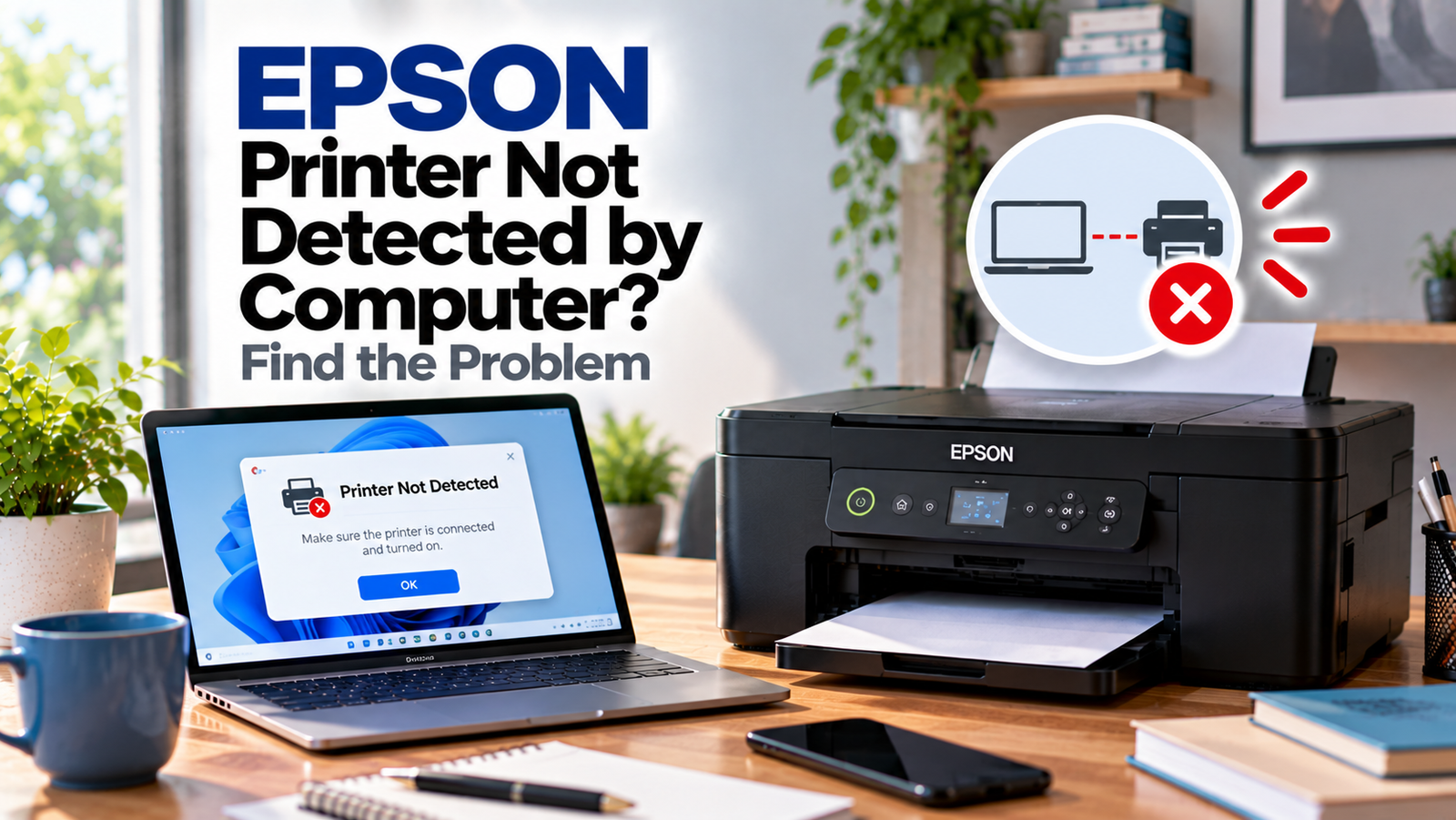
Epson Printer Not Detected by Computer? Find the Problem
If your Epson Printer Not Detected by Computer, the problem may be the USB connection, Wi-Fi network, printer software, driver, printer port, or the way the printer was added to the computer. The printer can be powered on and even connected to Wi-Fi while still being invisible to the computer.
The quickest way to diagnose the problem is to determine whether you’re using USB or Wi-Fi, then check whether the operating system can see the printer at all. Epson’s troubleshooting guidance recommends checking the physical connection, network status, printer software, driver and printer configuration when the computer cannot communicate with the product. Epson Support Files
Quick Diagnosis: Start Here
| What you’re seeing | Start here |
|---|---|
| The printer doesn’t appear anywhere on your computer | Go to Fix 1 |
| You use a USB cable | Go to Fix 2 |
| You use Wi-Fi | Go to Fix 3 |
| The printer is connected to Wi-Fi but the computer can’t find it | Go to Fix 4 |
| You recently changed your router or Wi-Fi network | Go to Fix 5 |
| Windows shows an old or duplicate Epson printer | Go to Fix 6 |
| The printer appears but Windows can’t communicate with it | Go to Fix 7 |
| The Epson driver or software may be missing | Go to Fix 8 |
| The printer was previously detected but disappeared | Go to Fix 9 |
| Nothing makes the computer recognize the printer | Go to Fix 10 |
Why This Happens
A computer may fail to detect an Epson printer for several reasons:
- The printer isn’t powered on or ready
- A USB cable or port is faulty
- The printer is connected through a problematic USB hub
- The printer and computer are on different networks
- The printer is connected to a guest Wi-Fi network
- The router has changed
- The printer’s IP address or network configuration has changed
- The Epson printer software isn’t installed correctly
- The correct Epson driver isn’t installed
- Windows has an old printer entry or incorrect port
- Network discovery is being blocked
- The printer’s network settings need to be reconfigured
Epson specifically recommends checking the printer’s network status, connection report, software installation, driver and connection type when its setup software cannot find the printer.
Fix 1: Make Sure the Printer Is Actually Ready
Start with the printer itself.
Check that:
- The printer is switched on.
- It has finished starting up.
- There are no active error messages.
- There is no paper jam.
- The printer isn’t displaying a network error.
- All required covers are closed.
If the printer has a display, check its network status as well.
Then restart both devices:
- Turn off the Epson printer.
- Shut down or restart the computer.
- Turn the printer back on.
- Wait for it to finish starting.
- Check the computer again.
If the printer still doesn’t appear, continue with the connection-specific fix below.
Fix 2: Check the USB Connection
If your Epson printer is connected by USB, start with the cable.
Disconnect the USB cable from the computer and printer, then reconnect it securely.
If the printer still isn’t detected:
- Try another USB port on the computer.
- Try another compatible USB cable.
- Connect the printer directly to the computer.
- Remove any USB hub or adapter from the connection while troubleshooting.
- Restart the printer and computer.
Epson specifically recommends trying another USB cable or port and connecting the product directly rather than through a USB hub when the connection isn’t recognized.
If the printer was previously installed through another USB port, Windows may also have retained an older printer entry. Continue to Fix 6 if that is the case.
Fix 3: Check the Printer’s Wi-Fi Connection
If you’re using wireless printing, first confirm that the Epson printer is actually connected to Wi-Fi.
Check the printer’s network settings or print a network status sheet if your model supports one.
Look for:
- Wi-Fi connection status
- Network name
- IP address
- Signal strength
- Network error messages
If the printer isn’t connected, reconnect it to Wi-Fi before trying to add it to the computer.
Epson recommends printing a network status or network connection report when troubleshooting network detection problems.
If the printer is connected to Wi-Fi but still isn’t detected, continue to Fix 4.
Fix 4: Make Sure the Computer and Printer Are on the Same Network
A Wi-Fi-connected Epson printer won’t necessarily be visible to every device connected to the internet.
Check the network name on both the printer and computer.
For normal network printing, they should generally be connected to the same local network.
Pay particular attention if your router has:
- A main network
- A guest network
- Separate 2.4 GHz and 5 GHz networks
- Network isolation or client isolation enabled
Epson specifically warns that a product connected to a guest network may not be discoverable and recommends checking that the computer and printer are using the same wireless network.
If both devices are on the same network and the printer still doesn’t appear, print a network connection report and continue to Fix 5.
Fix 5: Reconfigure the Printer After a Router Change
If the printer disappeared from your computer after replacing your router, changing the Wi-Fi name or changing your Wi-Fi password, the old network configuration may no longer be valid.
Reconnect the Epson printer to the new network.
If the printer’s network settings have become confused, Epson recommends resetting the product’s network settings and reinstalling the product software in situations where EpsonNet Setup cannot find the printer.
Do not immediately perform a full factory reset.
If possible, reset only the network settings, then run the Epson network setup procedure again.
After the printer successfully joins the network, check whether it appears on the computer.
Fix 6: Remove Old or Duplicate Epson Printer Entries
Windows can retain old printer installations after you change connection methods.
For example, you might have:
- Epson Printer
- Epson Printer Series
- Epson Printer (Copy 1)
- An old USB installation
- A newer Wi-Fi installation
If the computer has multiple entries, the one you’re selecting may not correspond to the printer’s current connection.
Remove obsolete printer entries and then add the current Epson printer again.
This is particularly useful if you previously used USB and have now switched to Wi-Fi.
Don’t remove a working printer installation unnecessarily. First identify which entry corresponds to the current printer.
Fix 7: Check the Printer Port
If Windows shows the Epson printer but cannot communicate with it, the printer may be associated with the wrong port.
This can happen after:
- Switching from USB to Wi-Fi
- Changing routers
- Reinstalling the printer
- Changing USB ports
- Adding the printer manually
Epson’s documentation specifically recommends checking that the Windows printer port corresponds to the actual printer connection.
If you’re not sure which port your printer should use, don’t randomly change ports.
Instead, reinstall or reconfigure the printer using Epson’s official setup software so that the correct connection is established automatically.
Fix 8: Install the Correct Epson Driver and Software
A printer can sometimes be physically connected but still not be properly recognized because the required Epson software or driver isn’t installed.
Check that you have the driver intended for your exact Epson model.
Epson states that using the genuine Epson printer driver is important because available functions can be limited when the correct driver isn’t installed.
If you’re unsure whether the software installation is damaged:
- Download the current software for your exact Epson model.
- Follow Epson’s installation procedure.
- Connect the printer when the installer asks you to.
- Allow the installer to detect the printer.
- Complete the setup.
- Restart the computer if requested.
Epson’s setup documentation specifically instructs users to make sure the printer is turned on and connected when the installer attempts to detect it.
Fix 9: Use Epson Printer Connection Checker
If you’re using Windows and the Epson software installation includes Epson Printer Connection Checker, use it to determine whether the computer can communicate with the printer.
The utility can help distinguish a connection problem from a printer software or configuration problem.
Epson includes Printer Connection Checker in its Windows troubleshooting workflow for situations where nothing prints or the computer cannot communicate correctly with the printer.
If the utility identifies a connection problem, follow its recommended steps before reinstalling everything.
For a network printer, also check the printer’s network status sheet and connection report.
Fix 10: Remove and Reinstall the Epson Printer
If you’ve confirmed that:
- The printer is powered on
- USB or Wi-Fi is working
- The printer is on the correct network
- The computer is using the correct connection
- The Epson software is installed
- The printer still isn’t detected
then a clean printer setup may be the most useful next step.
For Windows, remove the existing Epson printer installation and then reinstall it using Epson’s software for your exact model.
For Mac, check Printers & Scanners and remove the old printer entry if necessary before adding the Epson printer again.
Epson’s software-installation guidance recommends checking the printer list on Mac, ensuring the correct port is selected on Windows, and reinstalling product software when installation or detection problems persist.
If the Epson setup utility still cannot find the printer after a clean installation, use the network connection report or model-specific Epson support documentation to investigate further.
How to Prevent Epson Printer Detection Problems
A few simple practices can make future setup problems easier to avoid:
- Keep the Epson printer on the same local network as your computer.
- Avoid using a guest Wi-Fi network for the printer.
- Keep the printer’s network information available when troubleshooting.
- Use Epson’s software for your exact printer model.
- Avoid unnecessary USB hubs during setup.
- If you change routers, reconnect the printer rather than assuming it will automatically follow the new network.
- Remove obsolete printer installations when switching between USB and Wi-Fi.
- Keep the Epson driver compatible with your operating system.
Frequently Asked Questions
Why is my Epson printer not detected by my computer?
The most likely areas to check are the USB or Wi-Fi connection, printer software, driver, printer port and network configuration. Start by confirming that the printer itself is powered on and ready.
Why is my Epson printer connected to Wi-Fi but not detected?
Check that the printer and computer are connected to the same local network. Guest networks, network isolation and incorrect network configurations can prevent devices from discovering each other.
Why is my Epson printer not detected through USB?
Try another USB port and compatible cable, and connect the printer directly to the computer instead of through a USB hub. Epson recommends these checks when the USB connection isn’t recognized.
Why did my Epson printer disappear after I changed my router?
The printer may still be configured for the previous network. Reconnect it to the new Wi-Fi network and reinstall or reconfigure the Epson network software if necessary.
Should I reinstall my Epson printer driver?
If the physical or network connection is working but the computer still cannot communicate with the printer, reinstalling the correct Epson driver and software can help. Make sure you download software for the exact printer model.
Why does Windows show my Epson printer but not communicate with it?
The printer may be associated with the wrong port, an old connection or an outdated driver. Check the printer port and remove obsolete printer installations if necessary.
Can a guest Wi-Fi network stop my Epson printer from being detected?
Yes. Epson specifically identifies guest-network connections as a possible reason its network setup software cannot find the product.