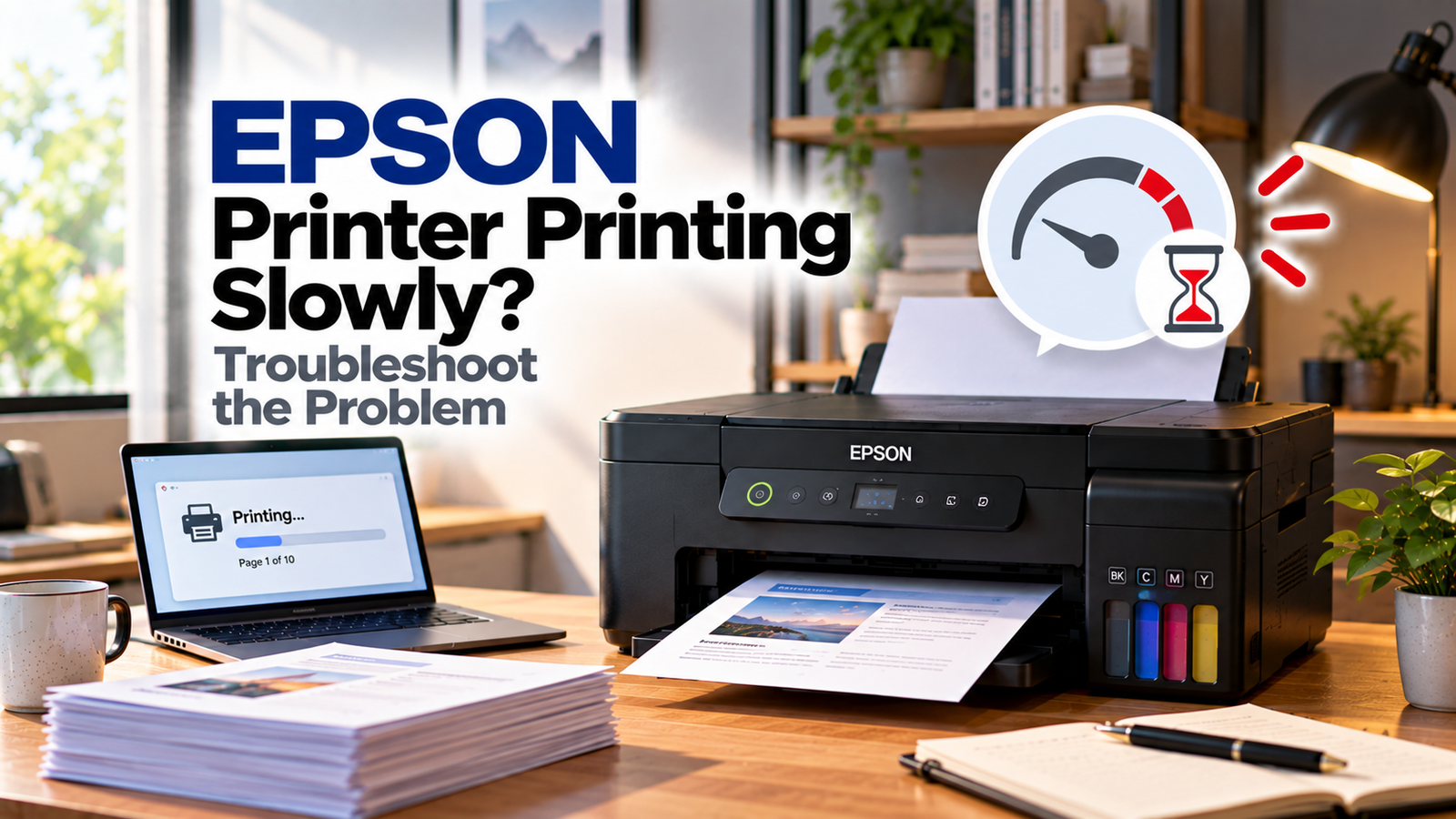
Epson Printer Printing Slowly? Troubleshoot the Problem
If your Epson Printer Printing Slowly, the delay may be caused by print quality settings, large documents, high-resolution images, paper type, connection problems, or printer software. A printer can also take longer when it is processing a complex document or performing maintenance before printing.
The best way to diagnose slow printing is to first determine whether every print job is slow or only certain documents. A simple text page that prints quickly points to a different problem than a large photo or multi-page document that takes several minutes to process.
Quick Diagnosis: Start Here
| What you’re seeing | Start here |
|---|---|
| Every document takes a long time to print | Go to Fix 1 |
| Photos or graphics print very slowly | Go to Fix 2 |
| Text documents print normally but images are slow | Go to Fix 3 |
| Printing became slow after changing print quality | Go to Fix 4 |
| Wi-Fi printing is much slower than before | Go to Fix 5 |
| USB printing is slow | Go to Fix 6 |
| The printer pauses between pages | Go to Fix 7 |
| A print job takes a long time to start | Go to Fix 8 |
| Printing became slow after a software change | Go to Fix 9 |
| Nothing improves the printing speed | Go to Fix 10 |
Why This Happens
An Epson printer may print slowly because of:
- High print-quality settings
- Photo or graphics-heavy documents
- Very large image files
- Special paper or media settings
- Slow Wi-Fi communication
- USB connection problems
- Large print jobs taking longer to process
- Printer maintenance operations
- Driver or software problems
- A slow computer processing the print job
- Settings designed to improve print quality rather than speed
Not every slow print job indicates a printer fault. High-quality photos and documents containing large graphics can take considerably longer to process and print than simple text.
Fix 1: Print a Simple Text Document
Start by testing the printer with a very simple document.
Create a new document containing only a few lines of text and print it using your normal settings.
Then compare the result with the document that was printing slowly.
If the simple document prints quickly
The printer itself may be working normally.
The original document could contain:
- Large images
- High-resolution graphics
- Complex layouts
- Multiple pages
- Embedded objects
- Large amounts of print data
If even the simple document prints slowly
The problem is more likely to involve:
- Print settings
- Connection
- Driver/software
- Printer processing
- Printer maintenance
Continue with the following fixes.
Fix 2: Reduce Print Quality for Normal Documents
High-quality printing requires the printer to process more information and can significantly increase printing time.
If you’re printing everyday documents, check the print-quality setting.
Depending on your Epson model and driver, you may see options such as:
- Draft
- Standard
- Normal
- High
- Best
- Photo
For ordinary text documents, try a standard or normal quality setting.
You can switch back to a higher quality setting when printing photographs or documents where output quality matters more.
If the printer becomes noticeably faster after lowering the quality, the original setting was contributing to the delay.
Fix 3: Check Large Photos and Graphics
If text prints quickly but photographs or graphics take a long time, the size and complexity of the print data may be responsible.
Large images can contain substantially more information than a normal text page.
Before printing a large image, consider:
- Reducing unnecessary image resolution
- Cropping unused areas
- Resizing extremely large images
- Avoiding unnecessarily large embedded graphics
- Printing at a suitable quality level
You don’t necessarily need to reduce the quality of a photograph dramatically. The goal is to avoid sending unnecessarily large amounts of data to the printer.
This is especially useful when the printer is connected over a slower network.
Fix 4: Check Paper Type and Media Settings
Your Epson printer may change its printing behaviour depending on the selected paper or media type.
For example, settings intended for:
- Photo paper
- Matte paper
- Glossy paper
- Specialty media
may involve more detailed printing than standard plain-paper settings.
If you’re printing on ordinary office paper, check that the print driver isn’t configured for a specialty paper type unnecessarily.
Make sure the selected paper type matches the paper actually loaded in the printer.
If the printer became slow immediately after changing the paper or media setting, restore the appropriate setting and test again.
Fix 5: Check the Wi-Fi Connection
If your Epson printer is connected wirelessly, network communication can affect how quickly a print job reaches the printer.
This becomes particularly noticeable with large documents or images.
Check:
- Whether the printer has a strong Wi-Fi signal
- Whether the printer and computer are on the same network
- Whether the router is working normally
- Whether other network devices are experiencing problems
- Whether the printer is unusually far from the router
For a quick test, move the printer closer to the router if practical and print the same document again.
If printing becomes noticeably faster, the wireless connection may be contributing to the delay.
If the printer has recently started losing connection as well as printing slowly, troubleshoot the Wi-Fi connection rather than focusing only on print speed.
Fix 6: Check the USB Connection
A USB-connected Epson printer should generally communicate directly with the computer.
If printing is unexpectedly slow:
- Disconnect the USB cable.
- Reconnect it securely.
- Try another USB port.
- If possible, try another compatible USB cable.
- Avoid a USB hub while testing.
- Restart the printer and computer.
If the printer becomes faster after changing the cable or port, the original USB connection may have been contributing to the problem.
This is especially worth checking if the printer was recently moved or connected to a different computer.
Fix 7: Check Whether the Printer Is Pausing Between Pages
Pay attention to when the slowdown occurs.
There is a difference between:
- A long delay before the first page starts
- Slow printing once the page begins
- Long pauses between pages
If the printer prints normally but pauses between pages, it may be processing the next page or performing a printer-side operation.
Check whether the same behaviour occurs with a simple text document.
If only complex documents cause long pauses, the amount of print data may be responsible.
If even simple pages consistently pause for an unusually long time, continue with the driver and printer-software checks.
Fix 8: Check the Print Queue and Computer
A slow printer isn’t always the cause of a slow print job.
Your computer has to process the document before the printer can print it.
This can be particularly noticeable with:
- Very large PDFs
- High-resolution photographs
- Complex presentations
- Large spreadsheets
- Documents containing many images
Check whether the computer itself is taking a long time to process the document.
You can also try printing a simple text file.
If simple documents print quickly but large files take a long time to begin printing, the computer may simply need more time to process the print data.
Also check the print queue for multiple jobs waiting ahead of the document.
Fix 9: Check the Epson Driver and Software
If printing became slow after a Windows or macOS update, printer software change or driver installation, check the Epson driver.
Make sure the driver installed on your computer is intended for your exact Epson printer model.
A damaged, outdated or incorrect driver can affect communication and printer functionality.
If necessary:
- Check the currently installed Epson printer software.
- Download the appropriate software for your exact model.
- Remove the old installation if Epson’s instructions require it.
- Install the current compatible software.
- Restart the computer.
- Test with a simple document.
Don’t install a driver simply because the printer belongs to the same Epson product family. Use the software specified for the exact model.
Fix 10: Compare Different Connection and Print Settings
If the printer remains slow, use a controlled test rather than changing several things at once.
Try the same simple document using:
- Standard print quality
- Plain paper
- A direct USB connection, if available
- A normal text document rather than a large image
Then compare the result with your usual setup.
This can help identify whether the slowdown is coming from:
- Print quality
- Document size
- Paper settings
- Wi-Fi
- USB
- Computer processing
- Epson software
If the printer remains unusually slow even with a simple document and basic settings, the issue may be specific to the printer or its software configuration and may require model-specific Epson troubleshooting.
How to Prevent Epson Printer Printing Problems From Becoming Slow
A few simple habits can help maintain normal printing speed:
- Use standard quality for everyday documents.
- Reserve high-quality modes for photos and important graphics.
- Avoid unnecessarily huge image files.
- Use the correct paper-type setting.
- Keep the printer within a reliable Wi-Fi range.
- Avoid unnecessary USB hubs.
- Keep Epson printer software and drivers compatible with your operating system.
- Clear stalled print jobs before sending new ones.
- Don’t repeatedly resend a document while the computer is still processing the first job.
Frequently Asked Questions
Why is my Epson printer printing so slowly?
Slow printing can be caused by high print-quality settings, large documents, photo printing, paper settings, Wi-Fi communication, USB problems or printer software. Start by printing a simple text document to see whether the slowdown affects everything.
Why does my Epson printer print text quickly but photos slowly?
Photos contain substantially more image data than simple text. High-resolution photographs can therefore take longer for the computer and printer to process, especially when high print quality is selected.
Does print quality affect Epson printer speed?
Yes. Higher-quality settings can require more processing and more detailed printing. For everyday documents, a standard or normal setting can often provide a faster print job.
Why is my Epson printer slow over Wi-Fi?
A weak or unstable wireless connection can slow communication between the computer and printer, particularly with large print jobs. Check the printer’s Wi-Fi signal and try moving it closer to the router.
Can a USB cable make my Epson printer print slowly?
A poor USB connection can affect communication between the computer and printer. Try another USB port or compatible cable and connect the printer directly rather than through a hub.
Why does my Epson printer take a long time before printing starts?
The computer may be processing a large or complex document before sending the print data to the printer. Driver problems, print settings and connection issues can also contribute to a long delay before the first page.
Should I reinstall my Epson printer driver if printing is slow?
Not immediately. First test a simple document and check print quality, paper settings and the connection. If the slowdown began after a software or operating-system change and affects even simple documents, checking or reinstalling the correct Epson driver may help.