
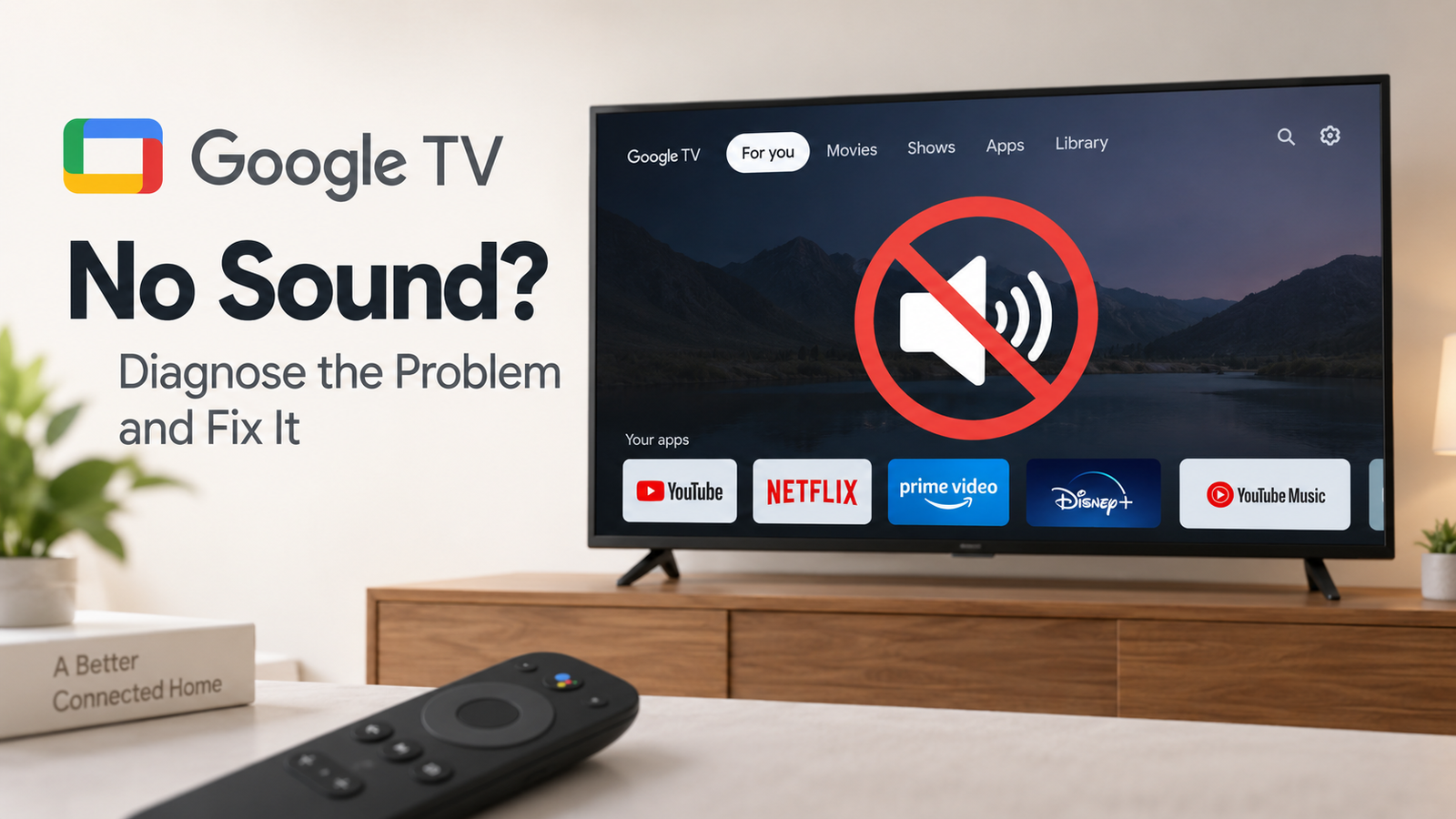
Google TV No Sound? Diagnose the Problem and Fix It
If you’re dealing with Google TV no sound, don’t immediately assume that your TV speakers or streaming device have failed. The cause can be as simple as a muted TV, the wrong audio output, an app-specific problem, or an audio format that your TV or soundbar doesn’t support.
The quickest way to troubleshoot the problem is to identify where the sound disappears. If every app is silent, you’ll troubleshoot differently than if only Netflix or YouTube has no audio. Similarly, a soundbar that suddenly stops playing audio points to a different problem than silent built-in TV speakers.
Use the quick diagnosis below to start with the most relevant fix.
Quick Diagnosis: Start Here
| What you’re seeing | Start here |
|---|---|
| Google TV has no sound anywhere | Go to Fix 1 |
| TV appears muted or volume buttons don’t change the sound | Go to Fix 2 |
| Only one streaming app has no sound | Go to Fix 3 |
| Sound disappeared after a temporary glitch | Go to Fix 4 |
| Built-in TV speakers work, but the soundbar or receiver doesn’t | Go to Fix 5 |
| Sound stopped after changing audio or surround settings | Go to Fix 6 |
| Stereo works but surround sound doesn’t | Go to Fix 7 |
| Audio problem started after connecting a soundbar or receiver between the Google TV device and TV | Go to Fix 8 |
Why This Happens
Google TV can send audio through several possible paths depending on your setup.
You may be using the TV’s built-in speakers, a soundbar connected through HDMI ARC or eARC, an AV receiver, or a Google streaming device connected through HDMI. The audio format also has to be compatible with the equipment receiving it.
That creates several possible failure points.
The TV may simply be muted, the wrong device may be controlling the volume, an individual streaming app may have developed a temporary problem, or your audio equipment may not support the format Google TV is trying to send.
External soundbars and AV receivers add another layer because HDMI, ARC/eARC and device-control settings can affect how audio travels through the system.
The symptom therefore matters more than trying every possible setting.
Fix 1: Check Whether All Apps Have No Sound
Start by determining whether this is a Google TV-wide problem or an issue with one streaming service.
Open two or three different apps and play something in each.
For example, try YouTube and another streaming service you normally use.
Also listen for interface sounds if your device normally produces them.
If every app is silent, continue with the system-level fixes below.
If other apps have normal audio but one particular app doesn’t, skip to Fix 3.
This simple test prevents you from changing system audio settings unnecessarily when the actual problem is confined to one app.
Fix 2: Check the TV Volume, Mute State and Remote Control
First, use the original remote supplied with your TV and increase the volume.
Make sure the television itself isn’t muted.
This is worth checking even if the Google TV remote appears to change the volume. Depending on your setup, the Google TV remote may be configured to control the streaming device, TV, receiver or soundbar.
If you’re using a Chromecast with Google TV or Google TV Streamer, you can review the remote configuration under:
Settings → Remotes & Accessories → Set up remote buttons
Check which device is configured for volume control.
If you use a soundbar or AV receiver, check its volume and mute status separately as well.
If normal audio returns, there is no need to change the Google TV audio format.
Fix 3: Troubleshoot the App if Only One Service Has No Sound
If YouTube has sound but another streaming app doesn’t — or vice versa — your overall audio connection is probably working.
Start by closing and reopening the affected app.
If the problem continues, restart Google TV using Fix 4.
You should also check whether an update is available for the affected app.
If necessary, clear the app’s cache from its settings. Menu wording can vary between Google TV devices, but app controls are generally available under:
Settings → Apps
Select the affected app and look for its storage or cache controls.
Avoid changing surround-sound or HDMI settings if every other app is playing audio normally. The evidence points toward the individual app rather than your entire audio setup.
Fix 4: Restart Your Google TV Device
A restart can clear temporary playback and system problems without deleting your apps or settings.
On many Google TV devices, go to:
Settings → System → Restart
Allow the device to restart completely and test the audio again.
If you’re using Chromecast with Google TV, you can also perform a full power restart by disconnecting its power cable, waiting about one minute, and reconnecting it.
Removing the Chromecast from the TV’s HDMI port alone does not reboot it. The device needs to be disconnected from its power source.
After it starts again, test more than one app.
Fix 5: Check Your Soundbar or AV Receiver Connection
If the TV speakers work but your soundbar or AV receiver doesn’t, concentrate on the external audio path.
First, confirm that the soundbar or receiver is powered on and using the correct input.
If your audio system connects through HDMI ARC or eARC, make sure it is connected to the television’s HDMI port specifically labelled ARC or eARC.
Also check the television’s audio-output setting. It should be configured to send sound to the external audio system rather than only to the TV speakers.
The exact menu names vary considerably between TV manufacturers, so check your TV manufacturer’s instructions if necessary.
A useful diagnostic test is to temporarily disconnect the external audio equipment and play sound through the TV speakers.
If audio works normally without the soundbar or receiver, you’ve narrowed the problem to the external audio connection, configuration or compatibility rather than Google TV playback itself.
Fix 6: Check the Google TV Audio Format
An incompatible audio format can result in missing audio even when the video plays normally.
On Chromecast with Google TV, look under:
Settings → Display & Sound → Advanced sound settings → Surround sound format selection
If you’ve manually enabled particular formats, make sure your TV, soundbar or AV receiver actually supports them.
If you’re using a Google TV Streamer, additional output-format options may be available under:
Settings → Display & Sound → Audio options → Output format
Automatic is generally the safest starting point because it allows the device to choose an appropriate format.
If the problem started immediately after manually changing an audio format, return to the previous or automatic setting and test again.
Don’t enable audio formats simply because they appear in the menu. The receiving equipment must support the format as well.
Fix 7: Test Without Surround Sound
If normal stereo audio works but certain movies, shows or surround-sound content becomes silent, the surround configuration deserves closer attention.
Open Google TV’s advanced sound settings and check the surround-sound configuration.
If you’ve manually selected supported formats, verify them against the specifications of your TV, soundbar or AV receiver.
As a diagnostic test, temporarily disable surround sound or use a basic compatible audio configuration.
Then play the same content again.
If audio returns, you’ve isolated the problem to surround-sound format compatibility rather than the app, network or speakers themselves.
You can then configure only the formats supported throughout your audio chain.
Fix 8: Test Google TV Directly With the Television
Some setups connect a Google TV streaming device to a soundbar or AV receiver first, with the video signal then passing to the television.
That adds another device to the HDMI chain.
If you’re using this type of setup, temporarily connect the Google TV device directly to an available HDMI port on the TV.
Test the same content again using the TV speakers.
If the sound works when Google TV is connected directly to the television, the soundbar, receiver, HDMI path or associated settings are likely involved.
You can then investigate the external audio setup without repeatedly changing Google TV apps or resetting the streaming device.
Where supported, another arrangement is to connect the Google TV device directly to the television and use the TV’s ARC/eARC connection to send audio to the soundbar or receiver.
How to Prevent Google TV Sound Problems
Once your audio is working again, a few practices can reduce repeat problems.
Leave audio-format detection on an automatic or compatible setting unless you have a specific reason to configure formats manually.
When using a soundbar or AV receiver, confirm that the entire audio chain supports the formats you enable. Your Google TV device supporting a format doesn’t necessarily mean every connected device supports it.
Keep Google TV and your streaming apps updated.
If you’re changing your home-theatre setup, test the TV speakers before and after adding the soundbar or receiver. That makes it much easier to identify which connection introduced the problem.
Most importantly, troubleshoot according to the symptom. One silent app doesn’t usually justify changing your entire TV audio configuration.
Frequently Asked Questions
Why does my Google TV have picture but no sound?
Picture without sound can result from the TV being muted, incorrect volume control, the wrong audio output, an incompatible audio format, an app problem, or an issue with a connected soundbar or AV receiver. Test multiple apps and, if possible, the TV’s built-in speakers to narrow down the cause.
Why does Google TV have sound on some apps but not others?
If several apps play sound normally but one doesn’t, the overall audio connection is probably working. Restart the affected app, check for updates and troubleshoot that app before changing system-wide audio settings.
Why does my Google TV soundbar have no sound?
Check that the soundbar is powered on, using the correct input and connected to the appropriate ARC/eARC port if that’s how your setup works. Also check the TV’s audio-output and HDMI control settings. Exact options depend on the television and soundbar manufacturer.
Can surround-sound settings cause Google TV to have no audio?
Yes. If your TV, soundbar or AV receiver doesn’t support the audio format being sent by the Google TV device, you can experience audio problems. Test an automatic or simpler compatible configuration to determine whether format compatibility is responsible.
Should I factory reset Google TV because there is no sound?
Not initially. Volume, app, restart, audio-format and external-device checks should come first. A factory reset removes your data and settings and is unnecessary for many audio problems.
Why do my TV speakers work but my soundbar doesn’t?
That usually indicates the Google TV content itself can produce audio and shifts attention toward the soundbar, ARC/eARC connection, HDMI configuration, audio output or format compatibility. Testing with the TV speakers is therefore a useful diagnostic step.
Does unplugging Chromecast from HDMI restart it?
No. For Chromecast with Google TV, disconnecting it only from the television’s HDMI port doesn’t reboot the device. Disconnect its power source, wait about one minute and reconnect it.
Related Troubleshooting
Google TV Apps Not Working or Loading? Diagnose the Problem and Fix It
Google TV Keeps Buffering? Diagnose the Problem and Fix It
Google TV Remote Not Working? Diagnose the Problem and Fix It
2 Comments
Comments are closed.