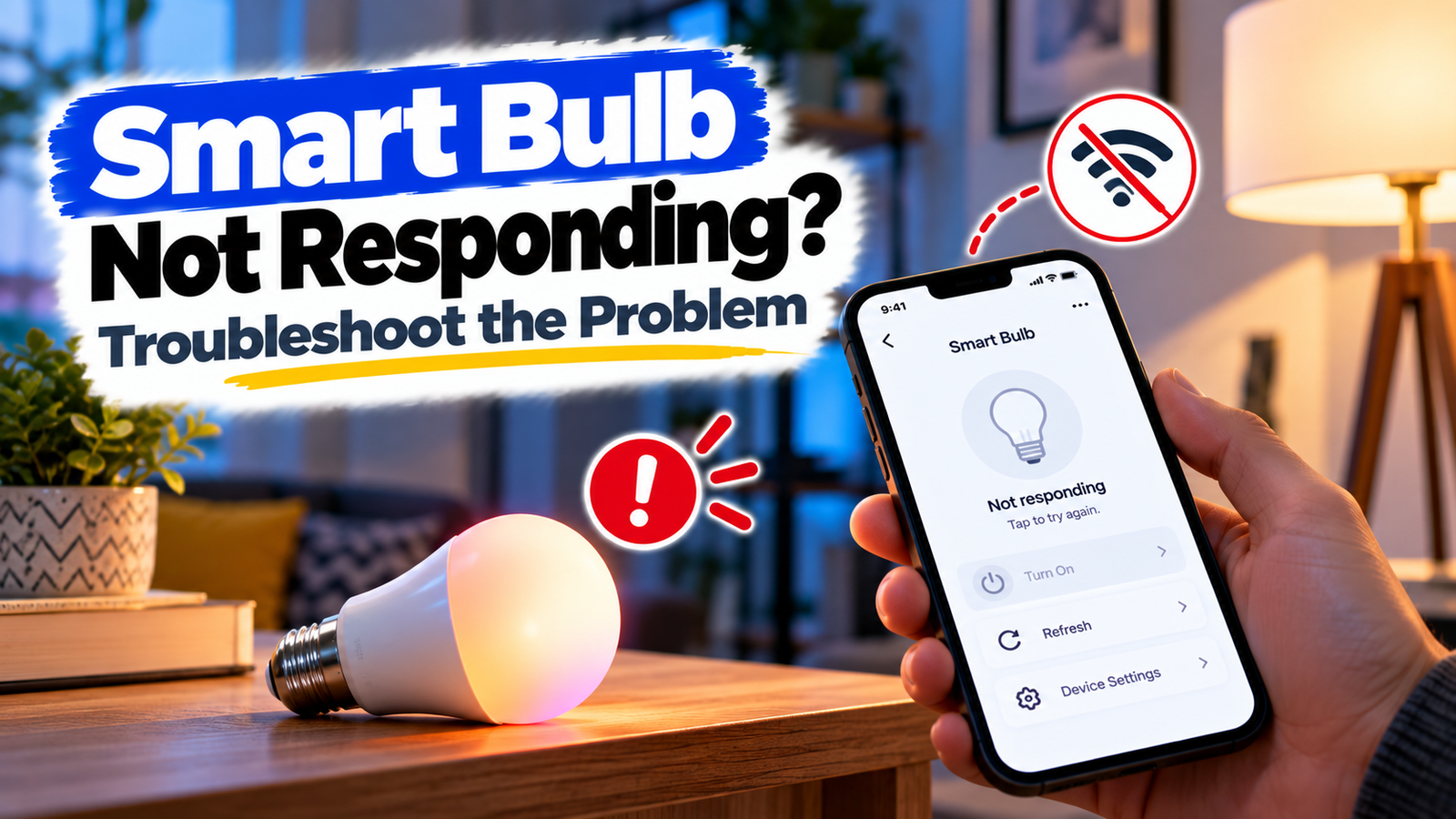
Smart Bulb Not Responding? Troubleshoot the Problem
If your Smart Bulb Not Responding, the bulb may still be connected to Wi-Fi but failing to react when you try to control it. You might tap the app and nothing happens, ask your voice assistant to turn it on and get no response, or find that the bulb works intermittently.
That makes this problem slightly different from a bulb that is completely offline. The first thing to establish is whether the bulb responds through its manufacturer’s app, smart-home platform, or physical power switch.
Once you know where the response stops, the right fix becomes much clearer.
Quick Diagnosis: Start Here
| What you’re seeing | Start here |
|---|---|
| The bulb doesn’t respond to anything | Go to Fix 1 |
| The bulb works after switching power off and on | Go to Fix 2 |
| The bulb works in its own app but not Google Home or Alexa | Go to Fix 3 |
| The bulb responds slowly or inconsistently | Go to Fix 4 |
| The bulb stopped responding from one location | Go to Fix 5 |
| Voice commands don’t work but the app does | Go to Fix 6 |
| Several smart devices aren’t responding | Go to Fix 7 |
| The bulb still won’t respond after everything else | Go to Fix 8 |
Fix 1: Check the Bulb’s Power
Start with the bulb itself.
Make sure the wall switch controlling it is turned on. If the bulb is installed in a lamp, check that the lamp is receiving power and that its physical switch hasn’t been turned off.
If you’re not sure whether the bulb is receiving power, turn it off, wait a few seconds, and turn it back on.
Then give it some time to reconnect before testing it from the app.
If the bulb doesn’t react at all after power is restored, try it in another compatible lamp or socket if that’s practical.
A smart bulb can’t respond to an app or voice command when the electrical connection to it has been interrupted.
Fix 2: Power-Cycle the Bulb
If the bulb has power but has stopped responding, a simple power cycle can clear a temporary connection problem.
Turn the bulb off at the wall switch.
Wait around 10 seconds, then turn it back on.
Give the bulb up to a minute to reconnect before testing it again.
This is worth trying before you remove the bulb from your app or perform a factory reset. A temporary communication problem doesn’t necessarily mean the bulb needs to be configured again.
If the bulb starts responding normally after the power cycle but becomes unresponsive again later, move on to the connection checks below.
Fix 3: Test the Bulb in Its Manufacturer’s App
This is the most useful test when you’re controlling the bulb through a smart-home platform.
Open the app that was originally used to configure the bulb and try switching it on or off.
If the bulb responds in the manufacturer’s app
The bulb itself is probably communicating correctly.
The problem is more likely to be with:
- Google Home
- Alexa
- The linked manufacturer account
- Device synchronization
- The smart-home integration
- The device name or command you’re using
In that situation, there’s no reason to reset the bulb immediately.
If the bulb doesn’t respond in its own app either
Focus on the bulb’s power and Wi-Fi connection instead.
This distinction can save you from repeatedly changing smart-home settings when the actual problem is further down the chain.
Fix 4: Check for a Slow or Unstable Response
A smart bulb that eventually responds isn’t necessarily suffering from the same problem as one that never responds.
Try several commands through the app.
For example, turn the bulb off, wait, and turn it back on. If supported, test brightness or colour changes as well.
Notice whether the bulb:
- Responds immediately
- Takes several seconds
- Responds only occasionally
- Responds to some commands but not others
If the response is inconsistent, check your Wi-Fi connection and signal strength.
A bulb installed far from the router may have enough connectivity to work occasionally but not enough for a reliable connection.
If the problem is isolated to one room, that location becomes an important clue.
Fix 5: Check the Bulb’s Location and Wi-Fi Signal
A bulb can be perfectly functional and still struggle to communicate if its wireless signal is poor.
This can happen when the bulb is:
- Far from the router
- On another floor
- Behind several walls
- Installed in an area with wireless interference
- Near equipment that creates significant radio interference
If possible, test the bulb in a location with better Wi-Fi coverage.
If it responds normally there, you’ve found an important part of the problem.
You may need to improve Wi-Fi coverage in the original room rather than repeatedly resetting the bulb.
If the bulb has a hub or bridge instead of connecting directly to Wi-Fi, check the connection between the bulb and that hub as well.
Fix 6: Check Voice Commands and Device Names
If the bulb works perfectly from its app but doesn’t respond when you speak to Google Home or Alexa, the bulb itself may be fine.
Check the name assigned to the bulb.
Keep it short and distinctive. Avoid giving several lights nearly identical names.
For example, Desk Light is easier to distinguish than several devices with names such as “Left Desk Light,” “Right Desk Light” and “Desk Light 1.”
Also check that you’re using the correct account and home in your smart-home app.
If you’ve recently renamed, moved or reconfigured the bulb, sync your smart-home devices before testing the voice command again.
If voice control is the only thing that has stopped working, don’t start by resetting the physical bulb.
Fix 7: Check Whether Other Smart Devices Are Affected
Is the problem limited to one bulb?
Try another smart device connected to the same network.
If several bulbs, plugs or other smart-home devices are suddenly refusing commands, the problem may be broader than one device.
Check:
- Your router
- Internet connectivity
- Other smart-home devices
- The manufacturer’s app
- Your smart-home platform
A router restart may be appropriate if multiple devices have lost connectivity.
On the other hand, if every other smart device works normally and only one bulb is affected, focus on that bulb rather than changing your entire network configuration.
Fix 8: Reset and Set Up the Bulb Again
If the bulb has power, the network is working, the manufacturer’s app can’t control it and the previous fixes haven’t helped, a factory reset may be the final practical step.
Resetting the bulb clears its existing configuration and allows you to set it up again.
Before doing that, make sure you have:
- The manufacturer’s app
- Your account credentials
- Your Wi-Fi password
- The correct setup procedure for the bulb
After resetting it, add the bulb as a new device and test it through the manufacturer’s app first.
Once it responds there, reconnect it to Google Home, Alexa or another smart-home platform if you use one.
If the bulb remains completely unresponsive even after a clean setup, the problem may be hardware-related.
Why This Happens
“Not responding” can describe several different problems.
A bulb with no power won’t respond at all. A bulb with a weak Wi-Fi connection may respond slowly or only occasionally. A bulb that works in its own app but not through Google Home or Alexa usually has a smart-home integration or account issue instead.
That’s why testing the bulb through different control methods is more useful than immediately resetting it.
Think of the chain as:
Power → Wi-Fi → Manufacturer’s app → Smart-home platform → Voice command
The first point in that chain where the bulb stops responding usually tells you where to concentrate your troubleshooting.
How to Prevent Smart Bulb Response Problems
A few simple practices can make smart bulbs more reliable:
- Keep the wall switch supplying continuous power.
- Install bulbs where they have reasonable Wi-Fi coverage.
- Keep the manufacturer’s app available even if you primarily use Alexa or Google Home.
- Give each bulb a simple, unique name.
- Avoid unnecessary Wi-Fi changes.
- If several smart devices stop responding together, check the network before resetting individual devices.
- Keep the bulb and relevant apps updated when updates are available.
Frequently Asked Questions
Why is my smart bulb not responding?
Check whether it has power first. If it does, test it in the manufacturer’s app and then check its Wi-Fi connection. If it works there but not through Alexa or Google Home, the problem is likely with the smart-home integration.
Why does my smart bulb work in the app but not with Alexa?
The bulb may have lost its connection to the manufacturer’s Alexa integration, or Alexa may not be correctly synchronized with the device. Check the linked service and device discovery before resetting the bulb.
Why does my smart bulb work in the app but not Google Home?
Google Home may have lost synchronization with the manufacturer’s service, or the bulb may be associated with a different account or home. Try syncing the devices and verify that you’re using the correct account.
Why does my smart bulb respond slowly?
A weak or unstable Wi-Fi connection is one possible cause. Check whether the bulb is far from the router or whether other smart devices are experiencing similar delays.
Why does my smart bulb stop responding after a few hours?
If it works initially and then becomes unresponsive, look for an unstable Wi-Fi connection, interrupted power or a network issue. Check whether the manufacturer’s app also loses access to the bulb.
Should I reset my smart bulb if it isn’t responding?
Not immediately. First check power, power-cycle the bulb, test it through the manufacturer’s app and check the network. A factory reset should generally be a later troubleshooting step.
Can a smart bulb be faulty even if it still turns on?
Yes. A bulb can continue producing light while having a problem with its wireless connection or internal smart controls. If it repeatedly fails to respond after a clean setup, hardware may be involved.