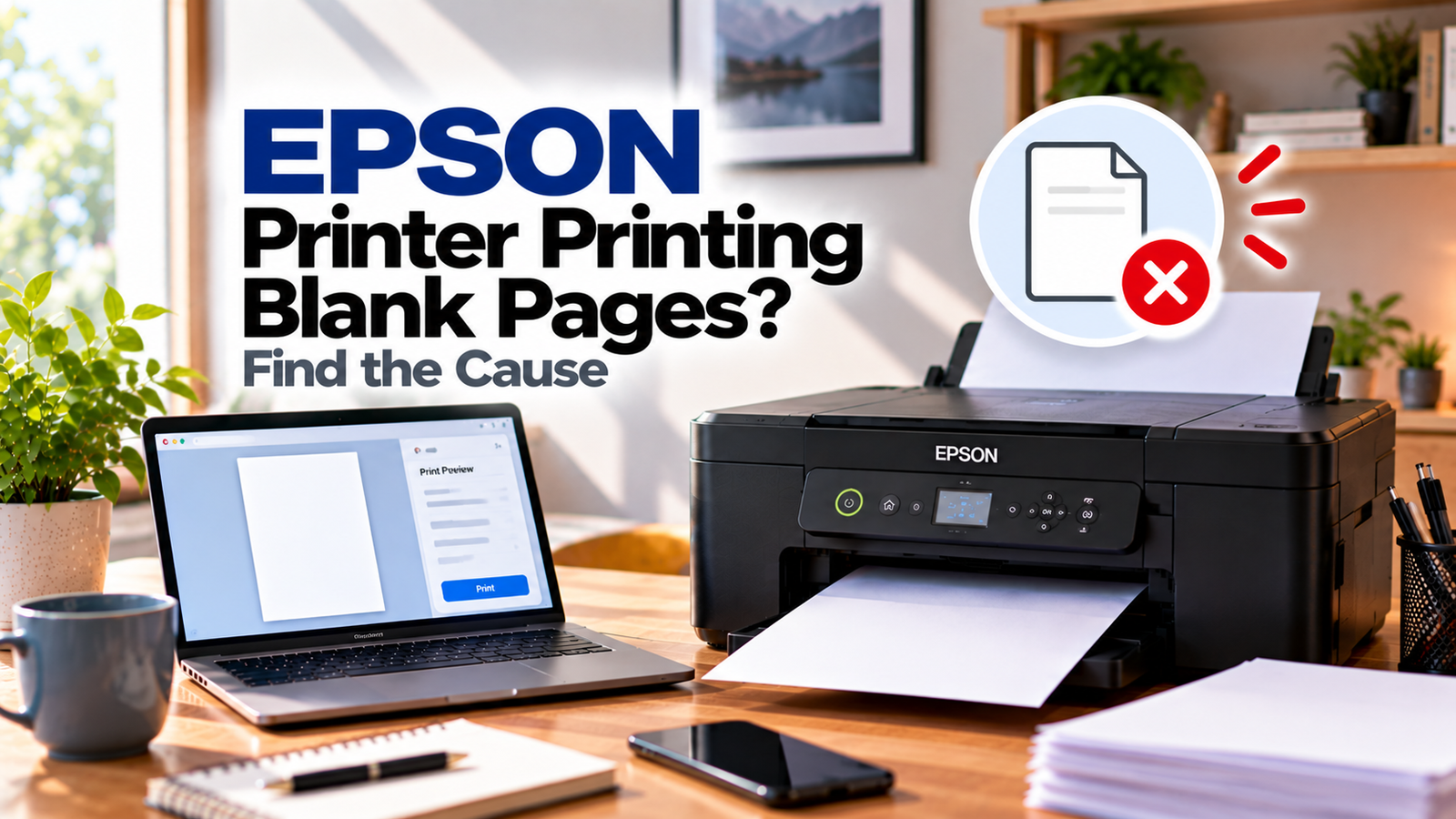
Epson Printer Printing Blank Pages? Find the Cause
If your Epson Printer Printing Blank Pages, the printer may be feeding paper normally but failing to put ink on the page. The cause can be something as simple as low ink or an incorrect print setting, but clogged print-head nozzles, unsuitable paper or a problem with the document can also be responsible.
The easiest way to narrow it down is to determine whether the printer can produce a nozzle-check pattern. If the nozzle check is also blank or has major gaps, focus on the ink delivery and print head. If the nozzle check looks normal, the problem is more likely to be the document, software or print settings.
Quick Diagnosis: Start Here
| What you’re seeing | Start here |
|---|---|
| The entire page comes out completely blank | Go to Fix 1 |
| The printer prints faint or incomplete text | Go to Fix 2 |
| Only some colours are missing | Go to Fix 3 |
| A nozzle check has gaps or missing lines | Go to Fix 4 |
| Ink levels are low or empty | Go to Fix 5 |
| A test page prints but your document is blank | Go to Fix 6 |
| Blank pages started after changing paper or settings | Go to Fix 7 |
| Several sheets feed and print blank | Go to Fix 8 |
| Cleaning hasn’t fixed the problem | Go to Fix 9 |
| Every print remains blank | Go to Fix 10 |
Why This Happens
An Epson printer can produce blank pages even when the paper feeds correctly.
Common causes include:
- Clogged print-head nozzles
- Low or empty ink
- Ink not flowing properly
- A print-head cleaning cycle being required
- Incorrect paper settings
- Incorrect print settings
- The wrong Epson printer being selected
- A blank page within the document
- A problem with the document or application
- Damp or unsuitable paper
- Multiple sheets feeding incorrectly
- A printer that is not sitting level
- A print-head or ink-delivery problem
Epson’s troubleshooting guidance specifically recommends checking the paper and print settings, confirming the correct printer is selected, checking ink levels and running a nozzle check when blank pages appear.
Fix 1: Check Whether the Entire Page Is Actually Blank
Start by looking closely at the printed sheet.
Is it:
- Completely blank?
- Extremely faint?
- Missing only certain colours?
- Printing text but not images?
- Printing only part of the page?
This distinction matters.
If everything is missing, the first thing to check is the printer’s nozzle pattern and ink supply.
If some elements appear but others don’t, the problem could instead be related to the document, print settings or specific clogged nozzles.
Before changing several settings at once, print a nozzle check if your Epson model supports it.
Fix 2: Print a Nozzle Check
A nozzle check is one of the most useful tests for an Epson inkjet printer.
It lets you determine whether ink is actually reaching the print head.
The exact menu varies by model, but you will generally find the option under the printer’s Maintenance or similar menu.
On supported Epson models, the process is typically:
- Load plain paper.
- Open the printer’s maintenance options.
- Select Print Head Nozzle Check.
- Print the pattern.
- Examine the lines and colour patterns.
A healthy nozzle pattern should appear complete and consistent.
If you see:
- Gaps in the lines
- Missing sections
- Very faint patterns
- One or more colours missing
the print head may need cleaning.
If the nozzle check itself comes out completely blank, focus on the ink supply and print-head problem rather than your document.
Fix 3: Check Whether Only Certain Colours Are Missing
If black prints but colour doesn’t, or one particular colour is missing, don’t assume the entire printer has failed.
Check the ink level for the affected colour.
Depending on the Epson printer, this could involve:
- Individual ink cartridges
- Ink tanks
- A combination of colour and black ink
If one colour is empty or very low, replace or refill it according to the instructions for your model.
If the ink level looks adequate but that colour is still missing from the nozzle check, run a print-head cleaning cycle.
This can happen when individual nozzles become clogged.
Fix 4: Clean the Print Head
If the nozzle check shows gaps or missing lines, the next step is usually Print Head Cleaning.
The exact procedure varies by Epson model, but the option is generally available through the printer’s maintenance menu or Epson printer utility.
After cleaning:
- Wait for the cleaning cycle to finish.
- Print another nozzle check.
- Compare it with the previous pattern.
- Repeat only if necessary.
Do not repeatedly run cleaning cycles without checking the result.
Print-head cleaning uses ink, and excessive cleaning can consume a significant amount of ink.
Epson’s guidance for supported models generally recommends checking the nozzle pattern after cleaning rather than continuously running cleaning cycles.
Fix 5: Check the Ink Levels
If the printer’s nozzle check is blank or severely incomplete, check the ink supply.
For cartridge-based printers, check whether any cartridge is empty or needs replacement.
For EcoTank and other tank-based models, check the visible ink levels.
Don’t rely only on the printer’s software estimate if your model allows you to visually inspect the ink.
Also make sure that:
- The correct ink has been used.
- Cartridges are installed correctly.
- Ink tanks have been filled as instructed.
- Any required protective material was removed during cartridge installation.
- The printer is not reporting an ink-related error.
If you’ve recently installed a new cartridge and the affected colour disappeared immediately afterward, recheck the cartridge installation before running repeated cleaning cycles.
Fix 6: Try a Different Document
If the nozzle check looks normal but your document prints blank, the printer hardware may not be the problem.
Try printing something completely different.
For example:
- Open a simple text document.
- Type a few words.
- Print it.
- Compare the result with the original document.
If the new document prints correctly, the original file or application may be causing the problem.
This can happen when:
- The document contains blank pages.
- Text or images are formatted incorrectly.
- A specific application has a printing problem.
- The file itself is damaged.
- Print content is hidden.
If your Epson printer software offers a Preview option, check the preview before printing.
If the preview itself is blank, the problem is likely with the document or application rather than the printer.
Fix 7: Check Paper Size, Type and Print Settings
Incorrect print settings can produce unexpected results.
Before printing again, check:
- Paper size
- Paper type
- Orientation
- Page range
- Layout
- Colour or black-and-white selection
- Print quality
Make sure the paper size selected in the application matches the paper actually loaded in the printer.
Also make sure you have not accidentally selected an unusual print mode that affects the output.
If the problem started immediately after changing print settings, restore the basic/default settings and try again.
Fix 8: Check the Paper Feed
If several sheets are feeding together, the printer may not be handling the paper correctly.
Epson notes that damp paper, unsuitable paper, improper loading or a printer that isn’t sitting correctly can contribute to paper-feed problems.
Remove the paper and check for:
- Dampness
- Curling
- Sheets sticking together
- Excessive paper in the tray
- Incorrect paper size
- Damaged sheets
Fan the paper before loading it again.
If the problem continues, try a fresh stack of suitable plain paper.
Also make sure the printer is sitting on a stable, level surface.
If multiple sheets are feeding together, the printer may not be making proper contact with each sheet, which can affect printing.
Fix 9: Try Cleaning Again, Then Let the Printer Rest
If the nozzle check remains poor after cleaning, don’t keep running cleaning cycles indefinitely.
Epson recommends a limited number of cleaning attempts on supported models. If the nozzle pattern doesn’t improve after repeated cleaning, some models recommend turning the printer off and allowing it to sit for several hours before checking again.
The exact recommendation varies by model.
For some Epson printers, a Power Cleaning option may be available when normal cleaning isn’t enough.
However, Power Cleaning uses considerably more ink, so it shouldn’t be the first step.
Before using it:
- Check the ink levels.
- Make sure the printer isn’t reporting an error.
- Confirm that normal cleaning hasn’t resolved the problem.
- Check the instructions for your exact Epson model.
If the nozzle pattern remains severely incomplete after the appropriate cleaning procedure, the issue may require service.
Fix 10: Determine Whether the Problem Is the Printer or the Computer
At this point, use the nozzle check to make the final distinction.
If the nozzle check is blank or badly damaged
The problem is likely related to:
- Ink supply
- Clogged nozzles
- Print-head cleaning
- Ink delivery
- The print head itself
Continue with the printer’s maintenance procedure for your model.
If the nozzle check is perfect
The printer is probably capable of producing ink correctly.
Focus instead on:
- The document
- Print application
- Printer selection
- Paper settings
- Print settings
- Driver/software
Try another application and another simple document.
If everything prints blank despite a normal nozzle check, reinstalling the Epson printer software may be worth trying.
If the printer still produces blank pages after the appropriate maintenance and software checks, professional service may be necessary.
How to Prevent Epson Printer Printing Blank Pages
A few simple habits can help prevent recurring blank-page problems:
- Don’t allow ink levels to remain critically low.
- Use paper supported by your Epson model.
- Store paper in a dry environment.
- Run a nozzle check when print quality starts deteriorating.
- Avoid excessive print-head cleaning cycles.
- Use the correct paper size and type settings.
- Keep the Epson printer software and driver up to date.
- Don’t leave an inkjet printer unused for extremely long periods if your model is susceptible to nozzle clogging.
- If you notice missing colours, address the problem early rather than waiting until pages become completely blank.
Frequently Asked Questions
Why is my Epson printer printing completely blank pages?
The most common areas to check are the ink supply and print-head nozzles. Start by printing a nozzle-check pattern. If that pattern is also blank or has major gaps, focus on the printer’s ink and print-head system.
Why does my Epson printer have ink but still print blank pages?
Visible ink does not necessarily mean that ink is reaching the paper correctly. Clogged nozzles or a print-head problem can prevent ink from being deposited even when the ink supply is adequate.
Why is my Epson printer printing some colours but not others?
A particular colour may be low, empty or affected by clogged nozzles. Check the ink level for the missing colour and run a nozzle check to see which part of the pattern is affected.
How do I know if my Epson print head is clogged?
Print a nozzle-check pattern. Missing lines, gaps or absent colours indicate that some nozzles may not be working correctly.
How many times should I clean my Epson print head?
Don’t repeatedly run cleaning cycles without checking the nozzle pattern. Epson’s recommended number of cleaning attempts varies by model. If cleaning doesn’t improve the pattern after the recommended attempts, follow your model’s instructions for waiting, Power Cleaning or service.
Why does my Epson printer print a blank page after changing cartridges?
Check that the cartridge is correctly installed and that any required protective material was removed. Then check the ink level and print a nozzle-check pattern.
Why does my Epson printer print a test pattern but not my document?
If the nozzle check looks normal, the printer’s ink-delivery system is probably functioning. Check the document, application, selected printer and print settings. Try printing a simple document from another application.