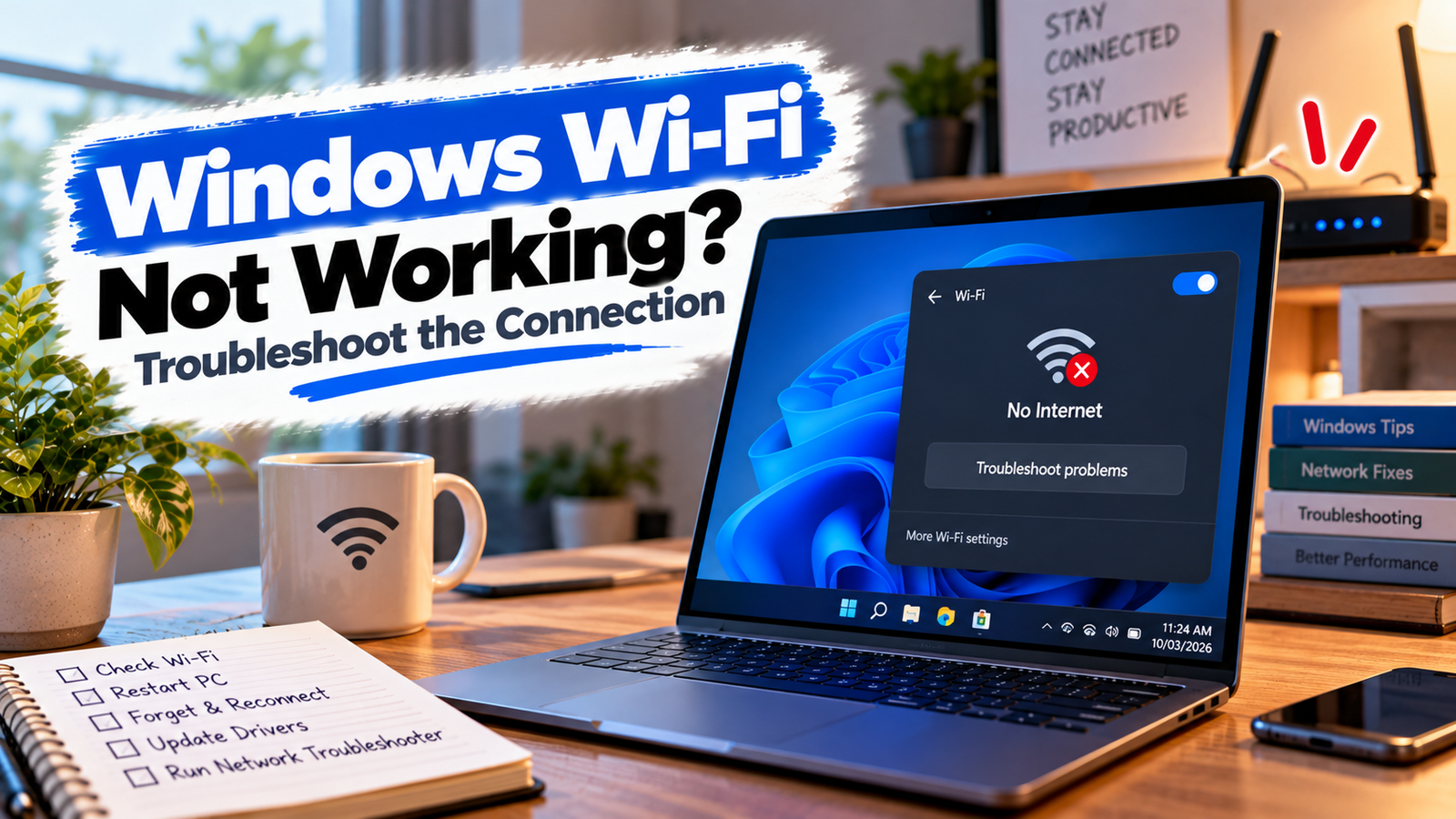
Windows Wi-Fi Not Working? Troubleshoot the Connection
If your Windows Wi-Fi Not Working, the problem can take several forms. Wi-Fi may have disappeared from Windows altogether, your PC may see your network but refuse to connect, or it may connect successfully while showing that there is no internet access.
Those symptoms point to different causes, so don’t jump straight to reinstalling the Wi-Fi driver or resetting your network. First work out where the connection is failing.
Quick Diagnosis: Start Here
| What you’re seeing | Start here |
|---|---|
| The Wi-Fi option is missing from Windows | Go to Fix 1 |
| Wi-Fi won’t turn on | Go to Fix 2 |
| Your network isn’t appearing in the list | Go to Fix 3 |
| Windows sees your network but won’t connect | Go to Fix 4 |
| Wi-Fi connects but there’s no internet | Go to Fix 5 |
| Wi-Fi keeps disconnecting | Go to Fix 6 |
| Wi-Fi stopped working after an update | Go to Fix 7 |
| Nothing restores the connection | Go to Fix 8 |
Fix 1: Check Whether Windows Can See the Wi-Fi Adapter
If the Wi-Fi option has completely disappeared from Windows, the first question is whether Windows can still detect the wireless adapter.
Open Settings → Network & internet and look for the Wi-Fi option.
If Wi-Fi isn’t listed at all, open Device Manager.
Right-click the Start button and select Device Manager, then expand Network adapters.
Look for a wireless adapter in the list.
You may see names containing terms such as:
- Wireless
- Wi-Fi
- WLAN
- 802.11
If the adapter is listed but has a warning symbol, Windows may be reporting a driver or device problem.
If you don’t see a wireless adapter at all, the adapter may be disabled, the driver may be missing, or Windows may not be detecting the hardware.
Don’t start downloading random drivers yet. Continue with the next check.
Fix 2: Make Sure Wi-Fi Isn’t Disabled
Windows can have Wi-Fi switched off even when the wireless hardware is working normally.
Open:
Settings → Network & internet → Wi-Fi
Make sure Wi-Fi is turned on.
Also check Airplane mode and make sure it is off.
On some laptops, there may also be a physical wireless switch or a keyboard shortcut that controls wireless connectivity. Check your laptop manufacturer’s instructions if the Wi-Fi setting keeps disappearing or switching itself off.
If Wi-Fi turns on but immediately switches off again, that points toward a deeper driver, hardware or system issue.
Fix 3: Check Whether Your Wi-Fi Network Appears
If Wi-Fi is available in Windows but your own network doesn’t appear in the list, check the router first.
Make sure:
- The router is powered on.
- Other devices can see the network.
- You’re close enough to the router.
- The network hasn’t been hidden.
- Your router hasn’t recently been reconfigured.
Try refreshing the available networks in Windows.
If other phones or computers can see your Wi-Fi network but this particular PC cannot, the problem is more likely to be with the PC’s wireless adapter, driver, compatibility or signal reception.
If no device can see the network, investigate the router instead.
Fix 4: Forget the Network and Connect Again
If Windows sees your Wi-Fi network but refuses to connect, the saved network information may be causing the problem.
Open:
Settings → Network & internet → Wi-Fi → Manage known networks
Find your network and choose Forget.
Then return to the Wi-Fi list, select the network and enter the password again.
Make sure you’re using the current Wi-Fi password, especially if you’ve recently changed it.
If Windows connects successfully after doing this, the old saved configuration was likely the issue.
If it still refuses to connect, pay attention to the exact message Windows displays. “Can’t connect to this network” can have several possible causes, including driver and router compatibility problems.
Fix 5: Check Whether Wi-Fi Works but Internet Does Not
A Wi-Fi connection and an internet connection aren’t exactly the same thing.
Windows may show that you’re connected to your wireless network while websites refuse to load.
First, check another device on the same Wi-Fi network.
If your phone also can’t access the internet, the problem is probably with your router or internet service rather than Windows.
If other devices work normally but the Windows PC doesn’t, try:
- Disconnecting and reconnecting to Wi-Fi.
- Restarting the PC.
- Restarting the router.
- Forgetting and reconnecting to the network.
- Temporarily disconnecting from a VPN.
If Windows reports Connected, no internet, don’t immediately assume the Wi-Fi adapter is faulty. The wireless connection itself may be working perfectly.
Fix 6: Check Why Wi-Fi Keeps Disconnecting
Intermittent Wi-Fi problems can be more difficult to diagnose because the connection may appear normal for several minutes before dropping.
Look for a pattern.
Does it happen:
- Only in one room?
- When you’re farther from the router?
- After the PC wakes from sleep?
- When you’re downloading large files?
- After a Windows update?
- At roughly the same time every day?
If the connection becomes stable when you’re closer to the router, weak signal strength may be involved.
If the problem affects other devices at the same time, investigate the router.
If only your Windows PC disconnects, check the wireless adapter and its driver.
Also restart the PC and router before moving into more advanced troubleshooting. A temporary connection problem doesn’t necessarily require a driver change.
Fix 7: Check the Wi-Fi Driver
If Wi-Fi stopped working after a Windows update, driver trouble is worth investigating.
Open Device Manager → Network adapters.
Find your wireless adapter and check its status.
If Windows reports a problem, you may need to update or reinstall the driver.
For the safest approach, use the driver supplied by your PC or motherboard manufacturer rather than downloading a driver from an unknown website.
If the problem started immediately after a driver update, the previous driver may also be relevant. Device Manager may provide a Roll Back Driver option when Windows has retained an earlier version.
Don’t change drivers repeatedly without a reason. First establish whether the problem actually began with the driver change.
Fix 8: Reset Windows Network Settings
If the Wi-Fi adapter is detected, the router is working and normal troubleshooting hasn’t restored the connection, Windows’ network configuration may need to be reset.
Windows 11 provides a Network reset option under:
Settings → Network & internet → Advanced network settings → Network reset
Network reset removes and reinstalls network adapters and returns certain networking settings to their defaults.
Because it can also remove saved network information and require you to reconnect to your networks, treat this as a later troubleshooting step rather than your first move.
After the reset, restart the PC and connect to your Wi-Fi network again.
If Wi-Fi still doesn’t work after a network reset, the problem may involve the adapter, driver, router compatibility or the hardware itself.
Why This Happens
“Wi-Fi isn’t working” can describe several completely different problems.
If the Wi-Fi option has disappeared, Windows may not be detecting or enabling the wireless adapter.
If your network appears but won’t connect, saved credentials, drivers or compatibility can be involved.
If you’re connected to Wi-Fi but have no internet, the wireless connection itself may be fine while the router or internet connection is having trouble.
And if Wi-Fi keeps dropping, signal strength, driver behaviour or router stability become more important clues.
The key is to identify which stage is failing:
Wi-Fi option → Network visible → Connection established → Internet access → Stable connection
Once you know where the chain breaks, you can troubleshoot the relevant part instead of changing unrelated settings.
How to Prevent Windows Wi-Fi Problems
A few simple habits can make wireless problems easier to avoid and diagnose:
- Keep your Windows PC and network drivers reasonably up to date.
- Keep the router firmware current when appropriate.
- Remember your current Wi-Fi password after changing it.
- Avoid unnecessary changes to router settings.
- Check whether other devices are affected before troubleshooting the PC.
- Keep the PC within reasonable wireless range.
- If a Wi-Fi problem begins immediately after an update, note the timing.
- Keep an Ethernet connection available when possible for driver or network troubleshooting.
Frequently Asked Questions
Why is Wi-Fi not showing on my Windows PC?
Windows may not be detecting the wireless adapter, Wi-Fi may be disabled, or the adapter driver may have a problem. Check the Wi-Fi setting and Device Manager first.
Why won’t my Windows PC connect to Wi-Fi?
The saved Wi-Fi configuration, password, wireless driver, router or network settings could be responsible. Forgetting the network and connecting again is a useful early test.
Why does Windows say Wi-Fi is connected but there is no internet?
Your PC may be connected successfully to the router while the router itself has lost internet access. Check another device on the same network to determine whether the problem is limited to the PC.
Why does my Windows Wi-Fi keep disconnecting?
Weak signal, router problems, driver issues or a problem with the wireless adapter can all cause repeated disconnections. Check whether other devices experience the same issue and whether the problem changes with distance from the router.
Should I reinstall my Wi-Fi driver?
Not immediately. First check Device Manager and establish whether Windows is reporting a problem with the adapter. If the issue began after a driver update, rolling back may be more appropriate than reinstalling a random driver.
Will resetting network settings fix Windows Wi-Fi?
It can fix problems caused by corrupted or incorrect network configuration, but it isn’t the right first step for every Wi-Fi problem. Network reset removes certain saved networking information, so use it after simpler checks have failed.
Why does Wi-Fi work on my phone but not my Windows PC?
If other devices connect normally, the router and internet connection are probably working. Focus on the Windows PC’s wireless adapter, driver, saved network configuration and signal reception.