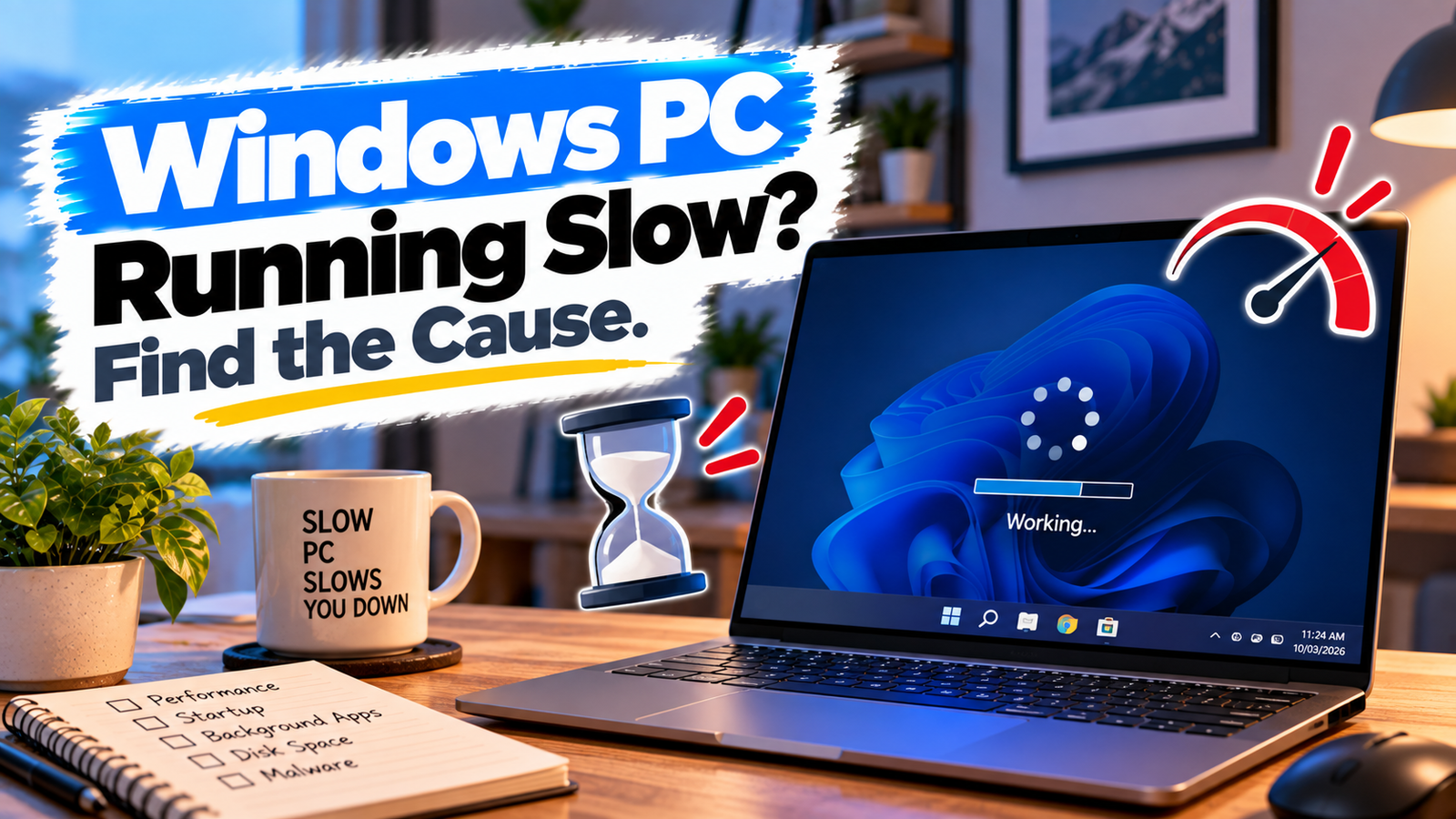
Windows PC Running Slow? Find the Cause
If your Windows PC Running Slow, the cause isn’t always obvious. A computer can become sluggish because too many apps are running in the background, storage is getting full, startup programs are piling up, or the hardware is simply struggling with what you’re asking it to do.
The useful thing is to look at what feels slow rather than immediately installing a “PC cleaner” or changing advanced Windows settings.
If the whole computer has become sluggish, start with the checks below. If only one app is slow, the problem may be specific to that application instead.
Quick Diagnosis: Start Here
| What you’re seeing | Start here |
|---|---|
| Everything feels slow, including Windows itself | Go to Fix 1 |
| The PC is slow mainly after startup | Go to Fix 2 |
| Apps become slow when several are open | Go to Fix 3 |
| The PC is almost out of storage | Go to Fix 4 |
| The computer has become slow recently | Go to Fix 5 |
| The PC gets slow while doing something specific | Go to Fix 6 |
| You suspect malware or unwanted software | Go to Fix 7 |
| The PC remains slow after the usual fixes | Go to Fix 8 |
Fix 1: Restart the PC and Check What Changes
If your computer has been running for days, a restart is a surprisingly useful first test.
Save your work, close your applications and restart Windows.
Once the PC comes back on, don’t immediately open everything you normally use. Give Windows a moment to finish loading, then try a few basic tasks.
Pay attention to whether:
- Windows opens menus normally.
- File Explorer responds quickly.
- Apps launch at a reasonable speed.
- The mouse and keyboard feel responsive.
- The PC becomes slow again only after you open certain programs.
If the computer feels noticeably better after restarting, something that was running during the previous session may have been consuming resources.
If it becomes slow again soon after startup, continue with the next checks.
Fix 2: Check Which Apps Are Slowing Startup
A PC can feel slow before you’ve even opened anything because several programs are launching automatically.
Windows allows you to see which applications start with the system.
Press Ctrl + Shift + Esc to open Task Manager.
Then select Startup apps.
Look at the apps listed there and pay attention to those with a high startup impact.
You don’t need every application to launch automatically. For example, a program you use only occasionally may not need to start every time Windows boots.
Select an unnecessary startup app and choose Disable.
Be selective, though. Don’t disable Windows components or software you don’t recognize simply because its name looks unfamiliar.
Restart the PC afterward and see whether startup feels faster.
Fix 3: Check CPU, Memory and Disk Usage
If the PC slows down when you have several programs open, Task Manager can tell you what’s consuming system resources.
Press Ctrl + Shift + Esc and open the Processes view.
Look at the CPU, Memory and Disk columns.
You may find that one application is consuming an unusually large amount of a particular resource.
For example:
- High CPU usage can make applications and Windows feel sluggish.
- High Memory usage can become a problem when many applications or browser tabs are open.
- High Disk activity can make the entire system feel slow, particularly when storage is under heavy load.
Close applications you aren’t using and see whether performance improves.
If one particular application repeatedly consumes excessive resources, investigate that application rather than treating the entire PC as the problem.
Fix 4: Free Up Storage Space
A nearly full system drive can contribute to poor performance and can also make Windows updates and other operations more difficult.
To check your storage in Windows 11, go to:
Settings → System → Storage
Look at how much space is available on your main drive.
If you’re running low, open Temporary files or use Storage Sense to identify files that can be safely removed.
You can also look for:
- Large files you no longer need
- Unused applications
- Temporary files
- Old downloads
- Files sitting in the Recycle Bin
Don’t randomly delete folders from the Windows directory just to create space.
The goal is to remove unnecessary data while leaving Windows and your important files intact.
If the PC is significantly short on storage, freeing up space can also make it easier to install Windows updates.
Fix 5: Check for Windows and Driver Updates
If the slowdown appeared recently, make sure Windows isn’t waiting for an update or a restart.
Go to:
Settings → Windows Update
Select Check for updates and install available updates.
Depending on your PC, optional driver updates may also be available.
Updates can include bug fixes, compatibility improvements and performance-related changes.
After installing updates, restart the computer if Windows asks you to.
If the slowdown started immediately after a particular update or software installation, make a note of that timing. It can be an important clue if the problem continues.
Fix 6: Find Out What Triggers the Slowdown
A PC that is slow all the time is different from one that slows down only during a particular task.
Try to identify the trigger.
For example, does the computer slow down when you:
- Open many browser tabs?
- Start a video call?
- Copy large files?
- Run a particular application?
- Play a game?
- Connect an external device?
- Work with large photos or videos?
Open Task Manager while the problem is happening.
Watch CPU, Memory and Disk usage as you reproduce the slowdown.
This can turn a vague complaint—”my PC is slow”—into something much more useful, such as “one application pushes CPU usage very high” or “memory usage becomes excessive when I open several programs.”
That information points toward a much more specific solution.
Fix 7: Check Windows Security for Malware
Malware and unwanted software can consume system resources in the background and make a computer noticeably slower.
You don’t need to install a random third-party cleaner just to perform a basic check.
Open:
Settings → Privacy & security → Windows Security → Virus & threat protection
Run a scan and allow Windows Security to check the system.
If it finds a threat, follow the recommended action.
Also be cautious about software that promises to “boost” Windows with one click. Some of these programs add more background processes rather than solving the underlying problem.
If the slowdown began after installing an unfamiliar program, uninstalling that software may be worth considering.
Fix 8: Consider Whether the Hardware Is the Limitation
If you’ve cleaned up storage, reduced unnecessary startup activity, checked for malware and confirmed that Windows is up to date, but the computer is still consistently slow, the hardware may be reaching its limits.
This is especially likely if:
- The PC is several years old.
- It has limited RAM.
- It uses older or slower storage.
- The processor struggles with newer applications.
- The computer becomes slow whenever several demanding programs are running.
- Performance has gradually declined as your workload has increased.
Open Task Manager and look at the system’s CPU, memory and disk activity while doing the things that normally cause the slowdown.
Older hardware won’t necessarily become fast simply because Windows has been cleaned up.
In some cases, a hardware upgrade—such as adding RAM or moving from an older hard drive to faster storage—can make a much bigger difference than another round of software cleanup.
If the hardware is no longer suitable for your everyday workload, replacing the PC may eventually make more sense than continually trying to optimize it.
Why This Happens
A slow Windows PC doesn’t have one universal cause.
Sometimes the problem is temporary: too many applications are open, a process is consuming resources, or the system simply needs a restart.
Other times, the slowdown is cumulative. Startup programs, background activity, large amounts of stored data and increasingly demanding software can gradually make an older PC feel less capable.
The best diagnostic clue is when the slowdown happens.
If Windows is slow immediately after starting, look at startup apps and background processes.
If it slows down only when you’re multitasking, check memory and CPU usage.
If the system drive is nearly full, address storage.
And if the PC remains slow even when very little is running, the hardware itself may be the limiting factor.
How to Prevent Windows From Getting Slow
You don’t need to constantly “optimize” Windows to keep a PC usable.
A few sensible habits are enough:
- Remove applications you no longer use.
- Keep unnecessary startup programs disabled.
- Don’t let the system drive become completely full.
- Install Windows updates regularly.
- Keep an eye on Task Manager when something suddenly becomes slow.
- Avoid installing questionable “PC booster” or cleaner software.
- Restart the PC when it has been running for a long time and performance starts deteriorating.
- Keep important files backed up, especially if the PC is getting older.
Frequently Asked Questions
Why is my Windows PC suddenly so slow?
A sudden slowdown can come from a background process, startup application, low storage, an update, malware or a particular application consuming excessive resources. Task Manager can help identify what changed.
How do I find out what is making my Windows PC slow?
Open Task Manager with Ctrl + Shift + Esc and look at CPU, Memory and Disk usage while the slowdown is happening. The resource that is consistently heavily used can provide an important clue.
Does low storage make Windows slow?
It can. A system drive that is running very low on free space can affect performance and may also cause problems installing Windows updates.
Should I disable all startup apps to make Windows faster?
No. Disable only startup applications you don’t need. Some programs and utilities may need to launch automatically, and disabling unfamiliar system-related software can cause other problems.
Can too many browser tabs slow down Windows?
Yes. Browsers can use substantial memory when many tabs are open, particularly when individual tabs contain demanding websites or applications. Check Memory usage in Task Manager if your PC becomes slow while browsing.
Can malware make a Windows PC slow?
Yes. Malicious software can consume CPU, memory or disk resources and run processes in the background. Windows Security can scan the system for threats.
What if my Windows PC is still slow after all these fixes?
If the PC remains slow with little running and has adequate free storage, the hardware may simply be struggling with your current workload. Older processors, limited RAM and slower storage can all become bottlenecks.