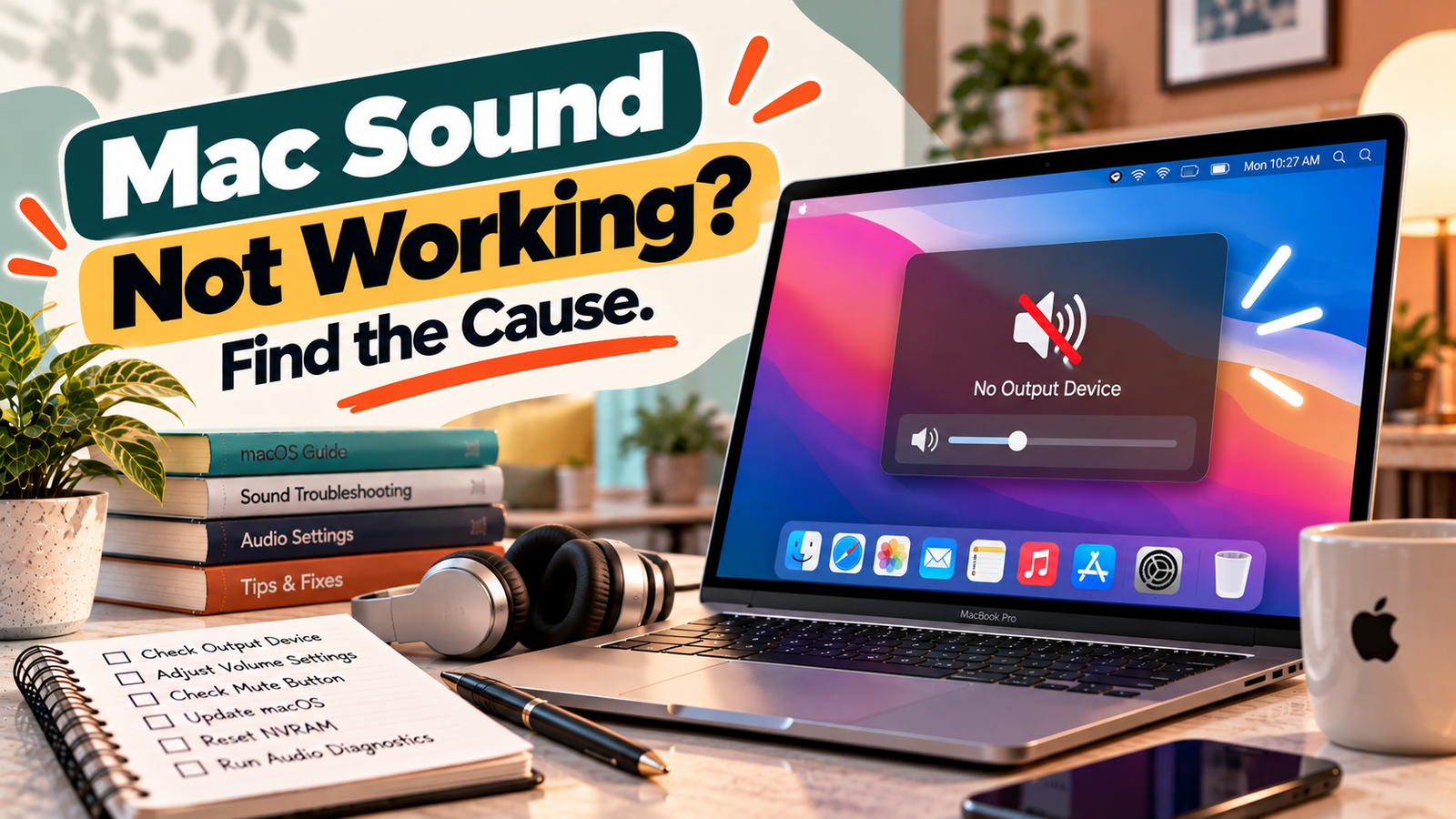
Mac Sound Not Working? Find the Cause
You press play on your Mac, the video starts, but there is no sound. Or perhaps you can hear system alerts but not music, video calls or audio in your browser. When Mac sound is not working, the symptom itself can reveal where to look first.
The problem might be as simple as the wrong output device being selected. Your Mac could be sending audio to a connected monitor, headphones or an AirPlay device instead of its built-in speakers. In other cases, the problem affects only one application, an external audio device or the Mac’s audio system more broadly.
Before changing system settings or attempting a reset, identify whether the problem affects all audio or just one source. That distinction will help you choose the right troubleshooting path.
Quick Diagnosis: Start Here
| What you’re seeing | Start here |
|---|---|
| No sound from any app or website | Fix 1 |
| Sound is playing through the wrong device | Fix 2 |
| Only one app or website has no sound | Fix 3 |
| The volume is low or sound is muted | Fix 4 |
| External speakers or headphones are not working | Fix 5 |
| Sound disappears when using an external monitor or AirPlay | Fix 6 |
| The Mac’s microphone is not picking up sound | Fix 7 |
| Audio stopped working after a restart, update or settings change | Fix 8 |
| The built-in speakers still produce no sound | Fix 9 |
Fix 1: Find Out Whether the Problem Affects All Audio
Start by testing more than one source of sound. This helps establish whether the issue is system-wide or limited to a particular application.
- Play a video in your browser.
- Open another application that produces audio, such as Music or Apple TV.
- Try a system alert sound by opening Apple menu > System Settings > Sound and selecting an available alert sound.
- Check whether any of these produce sound.
Pay attention to the results.
If sound works in one application but not another, your Mac’s audio output is functioning at least partially. The problem may be related to the application, its volume controls or its audio settings.
If no application produces sound, investigate the Mac’s output device and volume settings before looking at more advanced causes.
Also check whether you are testing audio that actually contains sound. A muted video, silent clip or paused media player can make a working audio system appear faulty.
What this tells you: If every source is silent, focus on system-level output settings. If only one source fails, move to the application-specific checks in Fix 3.
Fix 2: Select the Correct Sound Output Device
Your Mac can send audio to several destinations, including its built-in speakers, wired headphones, USB audio devices, compatible displays and AirPlay speakers. If the wrong destination is selected, sound may be playing somewhere you cannot hear it.
To check the output device:
- Open Apple menu > System Settings.
- Select Sound in the sidebar.
- Open the Output section.
- Select your Mac’s built-in speakers, or the external device you actually want to use.
- Play audio again.
The exact name of the built-in speakers varies by Mac model.
If you see a monitor, headset or wireless speaker selected unexpectedly, switching to the intended output may restore sound immediately.
Do not assume that selecting a device once guarantees it will remain selected. macOS can change the output when audio equipment is connected or disconnected.
What this tells you: If audio returns after selecting the correct output, the speakers were not necessarily faulty. The sound was being routed to a different destination.
Fix 3: Check the App or Website That Has No Sound
When music plays normally but a browser video remains silent, changing the Mac’s entire audio configuration is unlikely to be the best first move.
Check the application that is failing.
- Browser videos: Look for a muted player, a volume slider set to zero or a muted browser tab.
- Safari: Check whether the website is muted using the audio control in the browser’s address and search field area, when available.
- Music or video applications: Check the application’s own volume and playback settings.
- Video conferencing apps: Confirm that the correct speaker is selected within the application’s audio settings.
- Games and editing software: Review the application’s audio output or device selection if it offers one.
Close and reopen the affected application if its controls appear correct but playback remains silent. If the problem occurs only in a browser, try a different website that plays audio or test another browser.
For a browser-based meeting, remember that the application’s selected speaker may differ from the system-wide output device.
If the same application fails across several audio sources while other applications work normally, investigate its settings or available updates rather than changing unrelated macOS settings.
What this tells you: If audio works everywhere except one app or website, the fault is more likely to be application-specific than a complete failure of the Mac’s audio system.
Fix 4: Check Volume, Mute and Audio Balance
A low output level, muted sound or incorrect balance can make audio seem broken even when playback is working.
Open Apple menu > System Settings > Sound > Output and review the following:
- Make sure the output volume is not set to zero.
- Check that the Mute option is not selected.
- Review the Balance slider and make sure it is not positioned entirely towards one side.
- Test audio again.
If your Mac uses an external speaker, headset or monitor, check its physical volume controls as well. Some displays and speakers have their own volume settings independent of macOS.
Individual applications may also have separate volume controls. Raising the Mac’s output volume will not necessarily fix a player that has been muted within the application.
One useful distinction is between system alert volume and general output volume. They are related, but changing alert volume alone may not restore ordinary music or video playback.
What this tells you: If sound returns after adjusting volume, mute or balance, the issue was likely a setting rather than a hardware failure.
Fix 5: Troubleshoot External Headphones and Speakers
External audio equipment introduces additional connection points. A headset may be plugged in but not recognised, a USB speaker may not appear as an output device, or a wireless accessory may be connected without being selected for audio playback.
Start with the connection type you use.
For wired headphones or speakers:
- Check that the connector is fully inserted into the appropriate port.
- Confirm that the accessory is powered on if it requires external power.
- Check its own volume control.
- Open System Settings > Sound > Output and select the device if it appears.
- Disconnect and reconnect the accessory, then test again.
For USB or Thunderbolt audio devices:
Try another compatible port if one is available. If the device does not appear in the output list, check whether the Mac recognises it. You can inspect connected USB hardware through System Information, accessible from the Apple menu while holding Option on supported macOS versions.
For Bluetooth headphones or speakers:
Check that the accessory is connected in Bluetooth settings and then selected under Sound > Output. A saved Bluetooth device is not necessarily connected or actively receiving audio.
If possible, test the accessory with another compatible device. This helps determine whether the issue follows the accessory or remains with your Mac.
What this tells you: If another output device works normally, the problem may be isolated to the original accessory, its connection or its configuration. If no output works, return to the system-level checks.
Fix 6: Investigate Audio Problems With an External Monitor or AirPlay
Sound can disappear or move to an unexpected destination when you connect an external display, use an HDMI connection or stream audio through AirPlay.
For example, connecting a monitor with built-in speakers may cause macOS to select that monitor as the audio output. If the monitor’s speakers are muted or unsuitable for your setup, you may hear nothing.
To investigate:
- Open Apple menu > System Settings > Sound > Output.
- Check which device is selected.
- Select your Mac’s built-in speakers to test them independently.
- If you want audio through the monitor, select the monitor and check its volume and speaker settings.
- If using AirPlay, confirm that the intended destination is available and selected.
If the output keeps switching back to another device, disconnect external headphones or speakers temporarily and select the intended output again. macOS may revert to another available device when equipment is connected through a display or audio interface.
For AirPlay, check that the receiving device is available and functioning. Test the Mac’s built-in speakers to see whether ordinary local playback works.
What this tells you: If sound works through the built-in speakers but not through the monitor or AirPlay device, investigate that connection and its output settings rather than assuming the Mac’s internal audio has failed.
Fix 7: Check Microphone Input if Others Cannot Hear You
Not every audio problem involves sound coming out of your Mac. If people cannot hear you during a call or recordings contain no voice, investigate the input device.
- Open Apple menu > System Settings > Sound.
- Select Input.
- Choose the built-in microphone or the external microphone you intend to use.
- Speak normally and watch the input level meter, if available.
- Increase the input volume if necessary.
If the input meter responds to your voice, the Mac is detecting microphone input at that point. If it remains inactive, check whether the correct microphone is selected and whether an external headset is connected properly.
You should also check the affected application’s microphone settings. A video conferencing app may be using a different input device from the one selected in System Settings.
For app-specific access problems, open System Settings > Privacy & Security > Microphone and check whether the relevant application has permission to use the microphone. The precise options depend on the macOS version and application.
Do not confuse microphone input with speaker output. A Mac can play sound normally while its microphone is misconfigured, or record audio correctly while its speakers remain silent.
What this tells you: If the input meter responds but a particular application cannot hear you, check that application’s selected microphone and permissions. If the meter remains inactive across applications, investigate the input device and connection.
Fix 8: Restart Your Mac and Review Recent Changes
If sound stopped working after a software update, connecting an accessory or changing settings, a restart is a sensible next step.
Save your work and restart the Mac normally. After it starts again, test sound using a built-in application before reconnecting external audio equipment.
If the problem began after installing an audio utility, virtual audio device, recording tool or conferencing application, check whether it introduced a new output or input option. Some applications install audio components that can change how sound is routed.
Also check for appropriate macOS updates under Apple menu > System Settings > General > Software Update. Install updates when relevant, taking normal backup precautions before a major upgrade.
If the Mac is managed by your workplace or school, avoid removing configuration profiles or changing advanced system settings without consulting the administrator.
Do not delete system audio files or run unverified Terminal commands in an attempt to restart audio services. These steps can create further problems without identifying the cause.
What this tells you: If sound returns after a restart, a temporary software or device state may have been involved. If the failure persists, use the earlier tests to narrow down the affected output or input path.
Fix 9: Investigate Persistent Built-In Speaker Problems
If the built-in speakers remain silent after you have checked the output device, volume, application behaviour and connected accessories, it is time to consider a deeper issue.
First, disconnect external headphones, USB audio devices and external displays that could affect sound routing. Then open System Settings > Sound > Output and select the built-in speakers.
Test more than one application and, if possible, compare the result with another output device.
The pattern matters:
- If external headphones work but the built-in speakers do not, the issue may be specific to the built-in speaker path.
- If the built-in speakers work but one external device does not, investigate that device and its connection.
- If no output device produces sound, a broader software or audio-system problem may be involved.
These results help narrow the diagnosis, but they do not conclusively establish a hardware failure.
If the built-in speakers remain silent after these checks, contact Apple Support or an authorised service provider for assessment. Physical damage, liquid exposure or other signs of hardware trouble warrant professional attention rather than further software experimentation.
What this tells you: Persistent failure isolated to the built-in speakers may require service, while failure across multiple outputs calls for a broader assessment of macOS and the audio system.
Why This Happens
Audio on a Mac passes through several stages. An application generates sound, macOS processes it, and the system sends it to a selected output device. If any part of that path is misconfigured or not functioning properly, the result can be silence or unexpected playback.
The selected output is one of the most common distinctions to investigate. A Mac may send audio to a monitor, headset or AirPlay destination instead of its built-in speakers. Volume and mute settings can create a similar symptom without any underlying fault.
Application-specific problems are another possibility. A muted browser tab or a video conferencing app using the wrong speaker can prevent sound in one context while the rest of the system works normally.
External equipment adds further variables, including cables, power, device compatibility and independent volume controls. Software changes can also affect how audio devices are recognised or selected.
Microphone failures follow a separate input path. They may involve device selection, application permissions or the microphone itself, even when playback is unaffected.
The key is to identify whether the failure involves one application, one device, all output or microphone input. That distinction helps prevent unnecessary changes to a Mac that may only have a simple routing problem.
How to Prevent Mac Sound Problems
A few practical habits can reduce avoidable audio interruptions.
- Check the output after connecting equipment. A monitor, headset or AirPlay device may become the selected destination.
- Keep external speakers powered and connected correctly. Check their own volume controls as well as macOS settings.
- Review application audio settings. Video conferencing and recording applications may use different input and output devices from the system defaults.
- Install software updates appropriately. Keep macOS and relevant audio applications updated, with backups before major upgrades.
- Avoid unnecessary system modifications. Do not delete audio components or run unverified commands when ordinary settings checks can narrow down the issue.
- Test audio before important calls or recordings. Confirm both microphone input and speaker output rather than assuming that one guarantees the other works.
- Note when the problem occurs. Whether sound fails after connecting a monitor, opening one app or restarting the Mac can provide a useful diagnostic clue.
Frequently Asked Questions
Why is there no sound on my Mac even though the volume is up?
The Mac may be sending audio to the wrong output device, or the application itself may be muted. Check System Settings > Sound > Output, select the intended device and test another application.
Why does my Mac have sound in some apps but not others?
The problem may be limited to an application’s volume, a muted browser tab or its selected audio device. Check the affected app’s controls before changing system-wide sound settings.
Why does my Mac stop playing sound when I connect a monitor?
The Mac may automatically select the monitor as its audio output. Open Sound settings and choose the intended destination. If you want to use the monitor’s speakers, check its own volume and audio capabilities.
Why can I hear others during a call, but they cannot hear me?
Speaker output and microphone input are separate. Check System Settings > Sound > Input, select the correct microphone and review the application’s microphone permissions.
Should I reset my Mac’s audio settings?
Not as an initial step. Check the selected output, volume, application controls and connected devices first. More extensive changes are unnecessary when the cause is simply an incorrect output selection.
When should I get my Mac’s speakers checked?
Consider professional assessment if the built-in speakers remain silent across multiple applications after you have selected them correctly, checked volume and disconnected external audio equipment. Persistent failure does not prove hardware damage, but it warrants further diagnosis.
Related Troubleshooting
- Windows Sound Not Working? Find the Cause
- Mac Wi-Fi Not Working? Troubleshoot the Connection
- Mac Bluetooth Not Working? Find the Cause
Before publishing, link only to articles that are already live on GlitchWise. The Mac Wi-Fi and Mac Bluetooth articles drafted in this workflow should not be treated as published until their live status is confirmed.