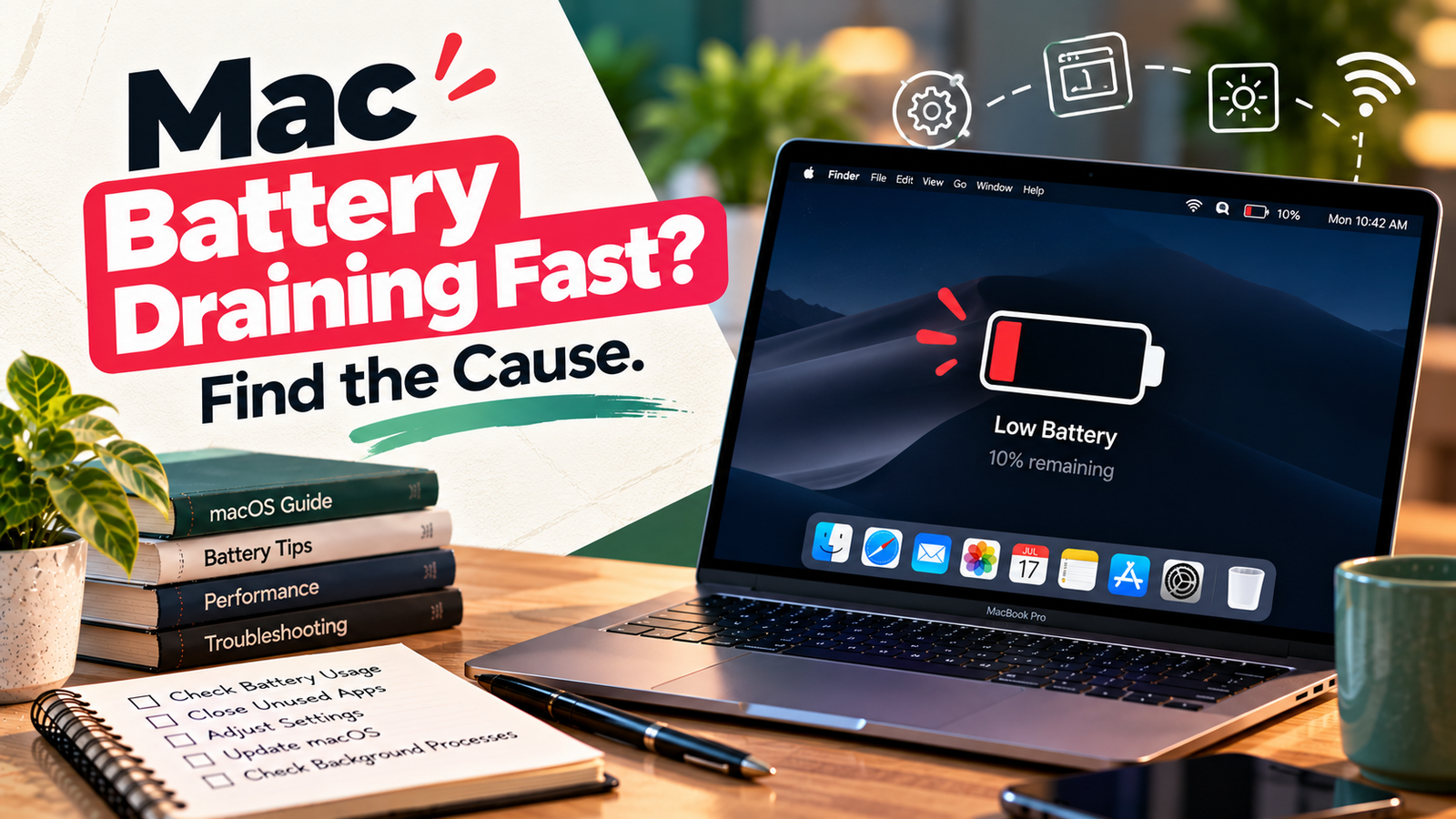
Mac Battery Draining Fast? Find the Cause
You unplug your MacBook in the morning, start working, and notice the battery percentage dropping much faster than expected. When your Mac battery is draining fast, the cause could be an app consuming excessive energy, display settings, background activity or a battery that has lost some of its original capacity.
The pattern matters. A battery that drains quickly while you are working may have a different cause from one that loses a substantial amount of charge overnight while the Mac is asleep. Similarly, a MacBook that used to last several hours but now needs frequent charging may warrant a closer look at battery health.
Rather than changing every power setting at once, use the checks below to identify where the energy is going and which troubleshooting step is most relevant.
Quick Diagnosis: Mac Battery Draining Fast?
| What you’re seeing | Start here |
|---|---|
| Battery percentage drops quickly during normal use | Fix 1 |
| One app seems to consume excessive battery power | Fix 2 |
| Battery drains even when the MacBook is asleep | Fix 3 |
| Screen brightness and display settings may be contributing | Fix 4 |
| Battery drains quickly when accessories are connected | Fix 5 |
| The MacBook gets unusually warm while running on battery | Fix 6 |
| Battery life became noticeably worse after a macOS update | Fix 7 |
| Battery life has declined over months or years | Fix 8 |
Fix 1: Check Your MacBook’s Battery Usage History
Before changing settings, look at how the battery has been behaving. macOS provides battery usage information that can help distinguish sustained power consumption from a brief drop during a demanding task.
- Open the Apple menu and select System Settings.
- Select Battery in the sidebar.
- Review the battery information and available usage history.
- Examine the Last 24 Hours and Last 10 Days views, where available.
- Compare battery levels with the periods when you were actively using the MacBook or leaving it asleep.
The exact information displayed depends on your Mac model and macOS version. Usage history can help you see when the battery level changed and how long the screen was active.
Consider what you were doing during the periods of faster drain. Video editing, gaming, video calls, large downloads and other demanding tasks can consume considerably more energy than writing documents or browsing simple web pages.
If the battery drops quickly even during light use, investigate background applications and battery health. If the decline corresponds to a demanding task, review that workload before assuming the battery is faulty.
What this tells you: Battery history establishes when the drain occurs and gives you a starting point for the more specific checks below.
Fix 2: Identify Apps That Are Using Excessive Energy
An application can consume battery power even when it is not the window you are actively using. Background processing, repeated syncing, demanding web pages and unresponsive tasks can all contribute to higher energy use.
To investigate:
- Open Applications > Utilities > Activity Monitor.
- Select the Energy tab.
- Review the listed applications and their energy-related information.
- Look for an app that appears to be consuming substantial energy relative to what it is doing.
- If necessary, switch to the CPU tab to investigate unusually high processor activity.
Activity Monitor’s Energy information can help identify applications that are contributing to power consumption. Avoid treating any single number as proof that an app is faulty, because energy use depends on the task being performed.
If a particular app stands out, close it normally and observe whether battery consumption changes during similar usage.
If the app repeatedly consumes excessive energy while idle, check for updates or review its background activity settings. A browser with many active tabs, for example, may continue processing content even when you are working elsewhere.
Do not terminate unfamiliar system processes simply because they appear in Activity Monitor. Focus on applications you recognise and understand.
What this tells you: If battery life improves after closing a particular application, that app or its workload may be contributing to the drain.
Fix 3: Investigate Battery Drain While Your MacBook Is Sleeping
A MacBook that loses a noticeable amount of charge overnight may be waking more often than expected or performing background tasks while you are not using it.
First, make sure you are comparing similar conditions. A battery that falls slightly overnight is not necessarily malfunctioning, particularly if the Mac is performing background work. A large or repeated drop deserves closer investigation.
Try the following:
- Save your work and close applications that are performing demanding tasks.
- Disconnect non-essential external accessories.
- Close the lid and allow the MacBook to sleep normally.
- Check the battery percentage before and after a consistent period of inactivity.
- Review the battery usage history to see whether the screen was active during the period.
If the battery continues to drain heavily, check whether any connected devices or applications may be keeping the Mac active. Network access and background activity can vary according to the Mac model, settings and software.
For a more controlled comparison, repeat the test without unnecessary accessories connected.
Avoid assuming that every overnight battery drop is caused by a particular macOS feature. The usage history and repeated observations are more useful than a single test.
What this tells you: If battery drain improves when accessories are disconnected or background activity is reduced, you have a useful clue about what may be consuming power while the MacBook is asleep.
Fix 4: Review Display Brightness and Energy Settings
The display is an important part of a MacBook’s energy consumption. Running it at maximum brightness for long periods can reduce the time you get from a charge.
Open Apple menu > System Settings > Displays and review the available brightness controls. Reduce brightness to a comfortable level and test whether battery life improves during comparable work.
Then open System Settings > Battery and review the available energy options.
Depending on your Mac model and macOS version, you may be able to:
- Enable Low Power Mode to reduce energy use.
- Configure the display to turn off after a shorter period of inactivity through the relevant display or lock-screen settings.
- Review other available energy-saving options.
Low Power Mode can be useful when you need longer battery life away from a charger. Keep in mind that it may reduce performance for some workloads.
You do not need to switch off every wireless feature or keep the display extremely dim. Make changes that suit your normal usage and compare the results.
What this tells you: If the battery lasts longer after reducing display brightness or enabling Low Power Mode, your previous settings or workload may have contributed to the faster drain.
Fix 5: Check Connected Accessories and Peripherals
External accessories can draw power from your MacBook, especially when connected through USB or another powered connection.
Examples include external drives, USB hubs, phones connected for charging and certain other peripherals.
To test whether an accessory is contributing:
- Disconnect non-essential external devices.
- Keep your usual applications and workload as consistent as possible.
- Use the MacBook on battery power for a comparable period.
- Compare the battery decline with your usual experience.
If you regularly connect an external drive, hub or phone, test the MacBook without it before changing other settings.
Also consider whether a connected device is being charged by the MacBook. Supplying power to another device can increase the Mac’s energy consumption.
You do not need to disconnect essential equipment permanently. The aim is to determine whether an accessory is making a meaningful difference.
What this tells you: If battery life improves noticeably without a particular peripheral, that accessory or the way you use it may be contributing to the drain.
Fix 6: Investigate Excessive Heat and Demanding Workloads
A MacBook that becomes unusually warm while running on battery may be performing demanding tasks in the foreground or background.
Video rendering, games, large downloads, photo-library processing and some browser activities can increase processor use and energy consumption. Heat can also influence how a Mac manages performance.
Check whether the battery drain coincides with:
- Fans running more frequently than usual, on models equipped with fans.
- An unusually warm case during light use.
- High CPU activity in Activity Monitor.
- A demanding task that continues after you switch to another application.
Close unnecessary demanding applications and place the MacBook on a hard, stable surface that allows proper ventilation.
If the Mac is processing a large library or completing an update, allow the task to finish when practical, then compare battery use under lighter conditions.
A warm MacBook does not automatically indicate a fault. However, persistent excessive heat during ordinary tasks, unexpected shutdowns or other unusual behaviour warrants further investigation.
Avoid trying to cool the computer with ice, refrigerated objects or direct moisture.
What this tells you: If the battery drain settles after demanding tasks finish and the Mac cools, workload or thermal conditions may have been responsible.
Fix 7: Check Whether Battery Drain Began After a macOS Update
Battery life can change temporarily after a software update while background tasks finish. If the drain started immediately after updating macOS, establish whether it persists once the system has settled.
Try these steps:
- Connect the MacBook to power when convenient and allow any ongoing update or setup process to finish.
- Restart the Mac normally if no installation is in progress.
- Open Activity Monitor and review energy and CPU usage.
- Check for applications that are consuming unusual resources.
- Compare battery usage again during your normal workload.
Do not repeatedly restart the Mac while an update or installation is underway.
If battery life remains poor, check whether the problem began after installing or updating a particular application. A third-party utility, browser extension or background process may be contributing independently of macOS.
You can also check System Settings > General > Software Update for relevant updates. Back up important data before a major operating system upgrade.
What this tells you: If battery life returns to normal after background activity settles, the change may have been temporary. Persistent drain requires further investigation into applications, settings and battery condition.
Fix 8: Check Battery Health and Maximum Capacity
If your MacBook used to last much longer on a full charge but now needs frequent charging despite similar usage, the battery’s condition deserves attention.
Rechargeable batteries gradually lose capacity as they age and go through charging cycles. A battery with reduced maximum capacity stores less energy than it did when new, even when the menu bar shows 100%.
To check its condition:
- Open the Apple menu and select System Settings.
- Select Battery.
- Find Battery Health and review the displayed condition.
- If available, click the information button beside the condition to view additional details, including maximum capacity.
The available information depends on the Mac model and macOS version.
If the battery condition indicates that service is recommended, or the system reports a battery service warning, arrange an assessment through Apple Support or an authorised service provider.
Maximum capacity is useful context, but it does not tell the whole story. Actual battery life also depends on workload, screen brightness, background activity and connected accessories.
If battery health appears normal but the MacBook still drains unusually quickly, return to the earlier checks instead of assuming that the battery needs replacement.
What this tells you: Reduced maximum capacity or a service recommendation can explain why your MacBook no longer lasts as long between charges. If battery health appears normal, investigate the conditions under which the drain occurs.
Why This Happens
MacBook battery life depends on both the amount of energy the computer consumes and the amount of energy its battery can store.
Applications performing demanding work use more power than lighter tasks. Background processes can also consume energy while you are working in another application or leaving the MacBook asleep. A bright display, connected peripherals and certain energy settings can add to the total.
Sleep-related drain follows a different pattern from rapid drain during active use. A MacBook that loses charge while asleep may be performing background activity or waking periodically, whereas a MacBook that drains quickly during normal work may be handling a demanding workload.
Battery ageing introduces another variable. Over time, the battery’s maximum capacity can decline, reducing how long the MacBook operates on a charge even if its energy consumption has not changed.
Software updates may temporarily affect power use while background tasks finish, but persistent drain should not automatically be attributed to an update.
The most useful distinction is whether the problem follows a particular activity, happens while the MacBook is asleep or persists regardless of workload. Each pattern points towards a different set of checks.
How to Prevent MacBook Battery Drain
A few practical habits can help you get more useful time from each charge.
- Adjust display brightness: Use a comfortable level rather than maximum brightness throughout the day.
- Review energy-intensive applications: Check Activity Monitor when battery consumption changes unexpectedly.
- Use Low Power Mode when appropriate: It can reduce energy use when you do not need maximum performance.
- Disconnect unused accessories: External drives, hubs and devices being charged can add to power consumption.
- Allow background tasks to finish: Large downloads, syncing and post-update processing may temporarily increase energy use.
- Keep macOS and applications updated: Relevant updates can include energy-efficiency improvements and software fixes.
- Monitor battery health: Check its condition periodically, especially if the MacBook’s runtime has declined over time.
- Avoid excessive heat: Use the MacBook in a suitable environment and keep its ventilation unobstructed.
If battery life changes suddenly, note what was running and whether the MacBook was awake or asleep. That information is more useful than changing multiple settings without measuring the result.
Frequently Asked Questions
Why does my MacBook battery drain so quickly even when I am not doing much?
A background application, syncing task or other process may be consuming energy. Check Activity Monitor’s Energy and CPU tabs, and compare the battery usage history with your normal activity.
Why does my MacBook lose battery overnight?
The Mac may be waking periodically or performing background work while asleep. Compare the battery level before and after a consistent sleep period, disconnect unnecessary accessories and review the usage history where available.
Does Low Power Mode improve MacBook battery life?
Low Power Mode is designed to reduce energy use and can extend battery life. Its effect depends on your workload, settings and Mac model, and some demanding tasks may run more slowly.
How do I know whether my MacBook battery needs replacement?
Check Battery Health in System Settings. A service recommendation or battery warning warrants further assessment. Reduced maximum capacity can also help explain shorter runtime, but battery drain must be considered alongside your workload.
Can a macOS update cause battery drain?
Battery usage may increase temporarily while background tasks finish after an update. If the drain continues, check Activity Monitor, application compatibility and battery health rather than assuming the update is the only cause.
Is it normal for a MacBook to lose some battery while asleep?
Some battery loss can occur, depending on the Mac, its settings and background activity. A large or repeated overnight drop deserves investigation, particularly if it represents a noticeable change from your MacBook’s previous behaviour.