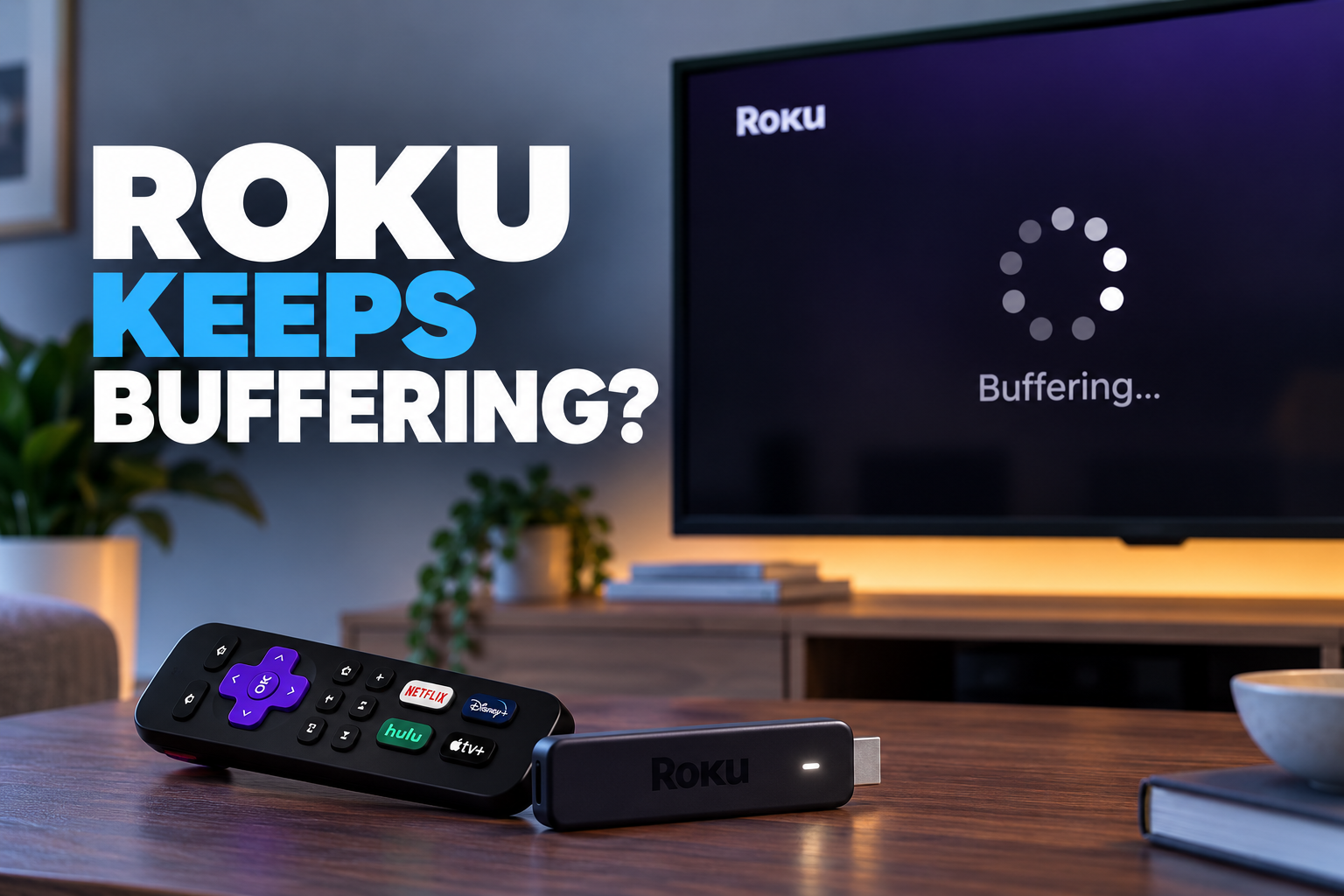
Roku Keeps Buffering? Diagnose the Problem and Fix It
If your Roku keeps buffering, freezing for a few seconds, or constantly showing the loading circle while streaming, the issue isn’t always your internet speed alone.
A useful clue is where the buffering happens. If only Netflix buffers while YouTube plays normally, that’s very different from every streaming app struggling. Likewise, a Roku connected to Wi-Fi with a Poor signal needs a different fix than one showing an Excellent signal.
This guide helps you diagnose the likely cause first, so you can fix the right problem instead of randomly restarting everything.
Quick Diagnosis: Start Here
| What you’re seeing | Start here |
|---|---|
| Every streaming app keeps buffering | Go to Fix 1 |
| Roku shows Fair or Poor Wi-Fi signal | Go to Fix 2 |
| Only one app keeps buffering | Go to Fix 3 |
| Buffering started after adding more devices to Wi-Fi | Go to Fix 4 |
| 4K or high-quality videos buffer more often | Go to Fix 5 |
| Roku still buffers after checking Wi-Fi | Go to Fix 6 |
Why This Happens
Roku buffering usually happens because the video isn’t reaching your device consistently enough for smooth playback.
The most common causes include:
- Weak Wi-Fi signal reaching the Roku
- Distance or obstacles between the router and Roku
- Network congestion from multiple connected devices
- A temporary router or Roku connection problem
- One streaming app experiencing its own playback issue
- High-quality video requiring more stable bandwidth than your connection can provide
The important thing is identifying whether the problem affects all apps or just one app. That immediately narrows down where you should troubleshoot.
Fix 1: Check Your Roku Network Connection First
Before changing anything, check what Roku says about your network.
On your Roku remote:
- Press Home.
- Open Settings.
- Select Network.
- Choose About.
- Check the displayed Signal Strength.
- Then select Check connection.
Roku will test both your connection to the wireless network and your connection to the internet.
You’re looking for two things:
- Signal Strength
- Connection Test Result
If Roku reports a weak signal or connection problem, continue to the next fix instead of troubleshooting individual apps.
Fix 2: Improve the Wi-Fi Signal to Your Roku
If your Roku shows Fair or Poor signal strength, the problem is likely the wireless connection between your router and the Roku rather than the streaming app itself.
Try these changes:
- Move the router higher if possible.
- Reduce the distance between the router and Roku.
- Remove obstacles such as cabinets or large furniture where practical.
- Keep the router out of enclosed spaces.
- If you’re using a Roku Streaming Stick behind the TV, consider using Roku’s HDMI extender if supported by your model to move it away from the TV’s rear panel.
After making changes, run Settings → Network → Check connection again and see whether the signal improves.
Roku specifically recommends improving placement and reducing interference before moving on to more advanced troubleshooting.
Fix 3: Find Out Whether Only One App Is Buffering
This is one of the most useful diagnostic checks.
Try playing:
- A video in the affected app
- A different show in the same app
- A video in another streaming app
For example:
- Netflix buffers but YouTube works normally
- Disney+ buffers but The Roku Channel plays smoothly
If only one app is struggling while others stream normally, the problem is more likely related to that streaming service or its app rather than your Roku’s overall connection.
At that point:
- Restart the affected app.
- Try another title.
- Confirm you’re signed into the app correctly.
- Check whether the same app works on another device in your home.
If every app buffers, continue with the network-focused fixes instead.
Fix 4: Restart Your Roku and Router Properly
A full restart can resolve temporary network communication problems.
Restart the Roku:
- Press Home.
- Go to Settings.
- Select System.
- Choose Power.
- Select System restart.
If your Roku doesn’t show a Power menu, look for System restart directly under System.
Now restart your network equipment:
- Unplug your modem.
- Unplug your router.
- Wait about 10–15 seconds.
- Plug the modem back in first.
- Wait for it to reconnect.
- Plug the router back in.
- Finally restart the Roku.
Once everything reconnects, test streaming again before making additional changes.
Fix 5: Reduce Network Congestion During Streaming
Sometimes the internet connection itself is fine, but too many devices are competing for available bandwidth.
This is especially noticeable when several people are:
- Streaming on different TVs
- Downloading large files
- Playing online games
- Backing up phones or computers to the cloud
As a quick test:
- Pause downloads on other devices.
- Disconnect devices that aren’t being used.
- Stream again on the Roku.
- Compare whether buffering improves.
If playback becomes smoother only after reducing activity on your network, congestion is likely contributing to the problem.
This doesn’t necessarily mean your internet plan is inadequate—it simply means available bandwidth is being shared across multiple devices at that moment.
Fix 6: Try the Other Wi-Fi Band or a Wired Connection
Many modern routers provide both 2.4 GHz and 5 GHz Wi-Fi.
Depending on your Roku model and router setup, switching bands may improve stability.
Check whether your router offers separate network names such as:
- HomeWiFi
- HomeWiFi_5G
If both are available, test the other compatible network and compare performance.
You can also check the wireless channel information under:
Settings → Network → About
If your Roku and router support Ethernet, a wired connection can also be a useful diagnostic test because it removes Wi-Fi from the equation.
If streaming becomes smooth over Ethernet, the issue is likely your wireless setup rather than Roku playback itself.
Fix 7: Check for a System Update
Keeping Roku updated ensures you’re running the latest available software.
To check manually:
- Press Home.
- Open Settings.
- Select System.
- Choose System update.
- Select Check now.
If an update is available, install it and allow Roku to restart normally.
This is worth doing when buffering began after a recent system change or when your device hasn’t been updated for some time.
Remember that software updates won’t usually fix weak Wi-Fi coverage, so continue addressing signal quality if Roku still reports Fair or Poor strength.
Fix 8: Test Another Network Before Considering Bigger Changes
If buffering continues despite improving your home Wi-Fi, try connecting the Roku temporarily to another internet connection, such as a mobile hotspot.
This is a diagnostic step—not a permanent solution.
If Roku streams smoothly on another network, that strongly suggests the issue lies with your home network, router configuration or internet service rather than the Roku itself.
If buffering continues even on another reliable network across multiple apps, further investigation may be needed through Roku Support or the relevant streaming service.
How to Prevent Roku Buffering
Not every buffering problem can be prevented, especially when it originates from an internet outage or a streaming service.
However, these habits can reduce recurring issues:
- Keep your router in an open, elevated position.
- Avoid placing Roku devices inside enclosed cabinets.
- Keep the Roku as close to the router as practical.
- Use the appropriate Wi-Fi band supported by your setup.
- Restart networking equipment occasionally if it becomes unstable.
- Keep Roku software updated.
- Reduce unnecessary bandwidth usage while streaming high-quality content.
The goal isn’t simply having Wi-Fi connected—it’s maintaining a stable connection strong enough for consistent streaming.
Frequently Asked Questions
Why does my Roku keep buffering even though it’s connected to Wi-Fi?
Being connected to Wi-Fi doesn’t guarantee a strong connection. Roku may still experience buffering if the wireless signal is weak, the internet connection is unstable or your network is heavily congested. Check Settings → Network → About and then run Check connection for a clearer diagnosis.
How do I check my Roku Wi-Fi signal strength?
Press Home → Settings → Network → About. Roku displays signal strength such as Poor, Fair, Good or Excellent. You can also select Check connection from the Network menu to test connectivity.
Why does only Netflix buffer on my Roku?
If only one streaming app buffers while others work normally, the problem is more likely related to that app or service than Roku’s overall network connection. Test another title and another app before troubleshooting your entire Wi-Fi setup.
Will restarting my router fix Roku buffering?
It can. Roku recommends restarting both the Roku device and router when troubleshooting connection-related streaming issues because temporary network communication problems can sometimes be resolved with a full restart.
Is 5 GHz always better for Roku streaming?
Not always. If your Roku and router both support 5 GHz, it can provide better performance in some homes, but range and wall penetration differ from 2.4 GHz. Testing both compatible bands is often more useful than assuming one will always perform better.
Should I factory reset my Roku because it keeps buffering?
No—not as an early troubleshooting step. Buffering is more commonly related to signal quality, internet connectivity, router performance or app-specific playback issues. Diagnose those first before considering a factory reset.
Related Troubleshooting
Roku Not Connecting to Wi-Fi? Try These Fixes →
Roku Keeps Restarting? Diagnose the Problem and Fix It →
Roku Black Screen? Diagnose Why There’s No Picture and Fix It →