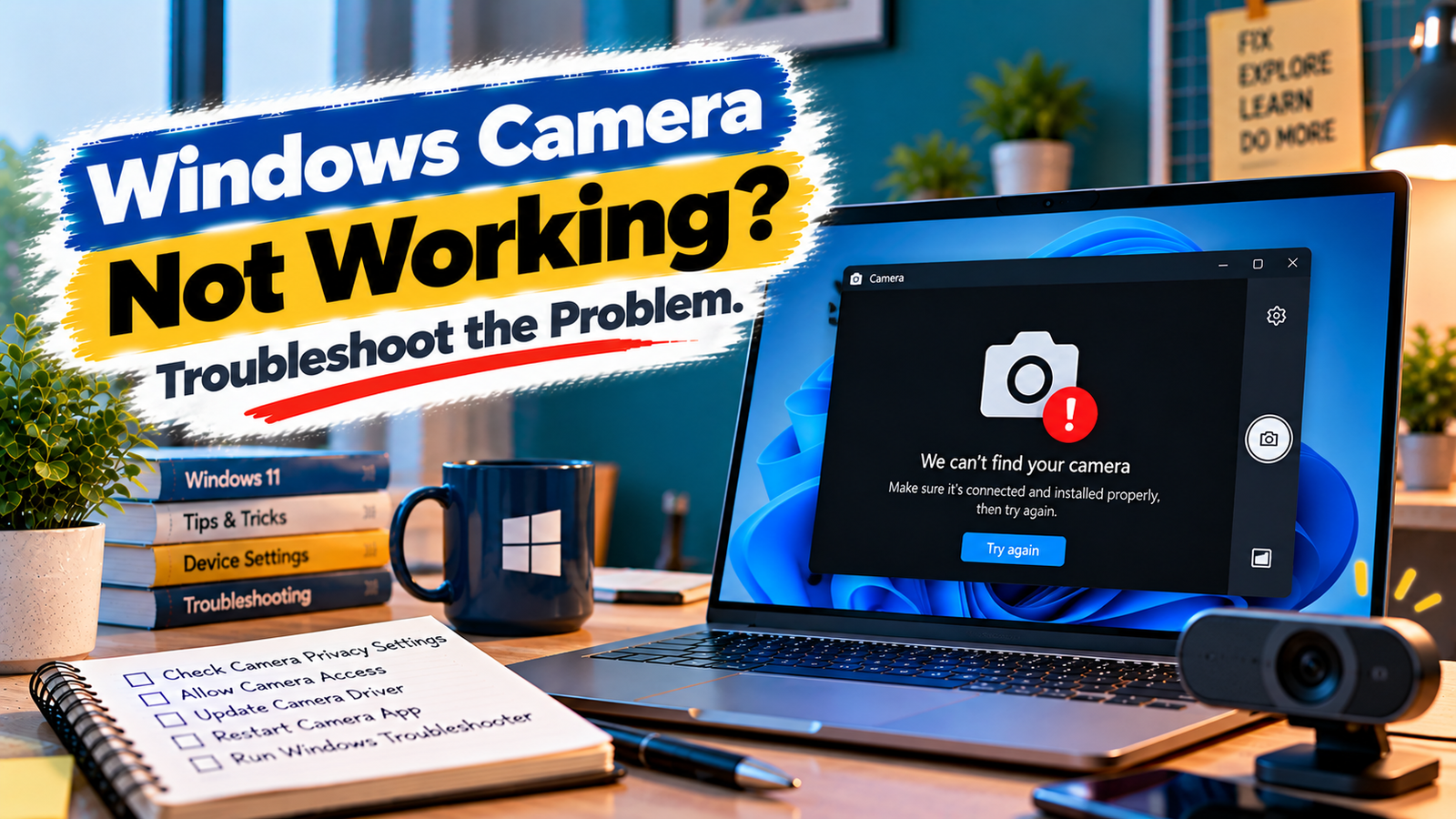
Windows Camera Not Working? Troubleshoot the Problem
You open a video call, switch on the camera, and get a black screen or Windows tells you it can’t find a camera at all. Sometimes the webcam works perfectly in one application but refuses to cooperate in another. Frustrating, especially when you need it for a meeting.
Before reinstalling drivers or changing Windows settings, check where the problem occurs. A camera that works in the Camera app but not in a video-calling app points to a different issue than one that isn’t detected anywhere. Let’s narrow it down.
Quick Diagnosis: Windows Camera Not Working?
| What you’re seeing | Start here |
|---|---|
| The camera isn’t detected by Windows | Go to Fix 1 |
| The camera is detected but shows a black screen | Go to Fix 2 |
| The camera works in one app but not another | Go to Fix 3 |
| Windows says camera access is blocked | Go to Fix 4 |
| The camera stopped working after an update | Go to Fix 5 |
| The camera keeps freezing or switching off | Go to Fix 6 |
| Nothing has restored the camera | Go to Fix 7 |
Fix 1: Check Whether Windows Can See the Camera
First, find out whether Windows recognises your webcam.
Open Settings → Bluetooth & devices → Cameras on Windows 11. On Windows 10, the available camera settings may be under Settings → Devices.
If your camera appears in the list, Windows can at least identify it. Select it, if available, and check whether its preview works.
If the camera isn’t listed, open Device Manager and look under Cameras or Imaging devices, depending on your system.
A missing camera could be disabled, disconnected, or affected by a driver issue. On a laptop, check for a physical camera switch or a keyboard privacy key that disables the webcam.
For an external USB webcam, unplug it and reconnect it, preferably using another USB port. If it still doesn’t appear, test the camera on another computer if possible.
That simple comparison helps establish whether you’re dealing with a Windows problem or a camera that isn’t functioning correctly.
Fix 2: Deal With a Black Screen or Blank Camera Preview
If Windows detects the camera but the preview is black, check whether another application is already using it.
Close video-calling apps, browser tabs and other programs that might have access to the webcam. Then open the built-in Camera app and test it again.
If the preview remains black, check the camera’s physical privacy shutter, if it has one. Some laptops also have a privacy feature that disables the camera electronically.
For an external webcam, check its connection and power requirements. If it has an indicator light, see whether it behaves as expected when you open the Camera app.
If the camera preview works in the Camera app but remains black in another program, the camera itself is probably functioning. Move on to the application and permission checks rather than changing the driver immediately.
Fix 3: Check the App That’s Trying to Use the Camera
A webcam can work normally in Windows while failing in Teams, Zoom, a browser or another application.
Open the affected app’s settings and look for its camera selection. If more than one camera is available, make sure it hasn’t selected a virtual camera or another device.
You should also check the browser’s site permissions if the problem occurs during a browser-based meeting. A website may have been denied camera access even though Windows allows it.
Close and reopen the application after changing the setting. If necessary, test the camera in a different app.
The result is useful: if the webcam works elsewhere, focus on the affected application’s settings, permissions or software rather than reinstalling the camera driver.
Fix 4: Allow Windows and Apps to Access the Camera
Windows privacy settings can prevent applications from using the webcam.
On Windows 11, open:
Settings → Privacy & security → Camera
Make sure camera access is enabled. Then check that apps are allowed to access the camera and that the relevant application has permission.
On Windows 10, open:
Settings → Privacy → Camera
The wording and available controls may vary slightly by Windows version.
Remember that desktop applications and Microsoft Store apps may be handled differently in these settings. If a particular desktop app still cannot access the camera, check its own privacy or device settings too.
If the controls are greyed out on a work or school computer, an administrator may have restricted camera access. In that situation, you may need your organisation’s IT team to change the policy.
Fix 5: Investigate a Recent Windows or Driver Update
Did the camera stop working immediately after a Windows update or driver change? That timing is worth investigating.
Open Device Manager, expand the camera category and open your webcam’s properties. Check the device status for any reported errors.
If the problem began after a driver update, a Roll Back Driver option may be available. Use it only when the timing supports a connection between the update and the camera failure.
If rollback isn’t available, check your laptop or webcam manufacturer’s official support resources for a compatible driver.
You can also review Settings → Windows Update → Update history to see which updates were installed around the time the problem started.
Avoid downloading drivers from unfamiliar websites. A driver that isn’t intended for your particular device can introduce further problems.
Fix 6: Stop the Camera From Freezing or Disconnecting
If the camera works briefly and then freezes, disappears or disconnects, look at the connection and the conditions under which it fails.
For a USB webcam, try another port and avoid using an unreliable hub while testing. If moving the cable or reconnecting the camera restores it temporarily, the connection or cable deserves closer attention.
For a laptop’s built-in webcam, check whether the problem happens in every application or only during long video calls.
If the camera disconnects across different apps, inspect Device Manager for device errors and check for an available manufacturer driver update. If it fails only in one application, investigate that app before changing system-wide settings.
Also check whether your PC is experiencing broader USB or power-related problems. If other USB devices disconnect at the same time, the issue may extend beyond the webcam.
Fix 7: Repair the Camera App or Investigate a Possible Hardware Fault
If the webcam works in some situations but the Windows Camera app itself keeps failing, try repairing the app.
Open Settings → Apps → Installed apps, find Camera, and open its available advanced options. If Windows offers Repair, try that first. Reset may also be available, but it can clear the app’s settings.
If the camera still isn’t detected or fails across multiple applications, return to Device Manager and check for reported errors.
For an external webcam, testing it on another computer is one of the most useful ways to narrow the cause. If it fails there too, the webcam or cable may be faulty.
For a built-in laptop camera, persistent failure across Windows apps—especially when the device is missing from Device Manager—may require manufacturer diagnostics or a hardware inspection.
You don’t need to reset Windows just because a webcam has stopped working. Establish whether the issue is the app, the driver, the connection or the camera itself first.
Why This Happens
Camera problems often look alike on the surface, but the cause can sit in very different places.
Windows may not recognise the hardware at all. The camera may be detected but blocked by privacy settings. An application might be using the wrong device, or a recent driver change may have affected how the webcam operates.
The quickest clue is where the camera fails:
- Missing from Windows: Check the connection, hardware switch, device status and driver.
- Black screen everywhere: Check privacy shutters, other apps using the camera and the device itself.
- Works in one app only: Focus on app permissions and camera selection.
- Started after an update: Investigate the driver or recent Windows change.
- Disconnects repeatedly: Check the cable, USB port, device errors and broader connection problems.
How to Avoid Camera Problems
A few small habits can save time when your webcam stops cooperating:
- Keep Windows and camera drivers updated through trusted sources.
- Check app permissions before changing drivers.
- Close video-calling apps when you’re finished using the camera.
- Keep external webcam cables and USB connections secure.
- Check for a physical privacy shutter before assuming the camera is broken.
- If the problem begins after an update, note the timing and investigate that change first.
Frequently Asked Questions
Why is my camera not showing up in Device Manager?
The camera may be disabled, disconnected, affected by a driver issue or not detected by Windows. Check physical privacy controls and connections first, then investigate the device status and driver.
Why does my webcam show a black screen?
Another app may be using the camera, a privacy shutter may be closed, or the camera may have a driver or hardware problem. Test it in the Windows Camera app to help narrow the cause.
Why does my camera work in Zoom but not in Teams?
The two applications may have different camera permissions or device selections. Check the camera selected inside the affected app and make sure Windows allows it to access the webcam.
How do I enable camera access in Windows?
Open the camera privacy settings and enable camera access. Then check app permissions for the program you want to use. The exact menu names depend on your Windows version.
Can a Windows update stop my webcam from working?
Yes, a driver or compatibility issue following an update can affect a camera. Check Device Manager and the update history, and investigate driver rollback or a compatible manufacturer driver if the timing fits.
How do I know if my webcam is broken?
If an external webcam fails across multiple applications and on another computer, the camera or cable may be faulty. If it works elsewhere, investigate Windows settings, drivers and application permissions.