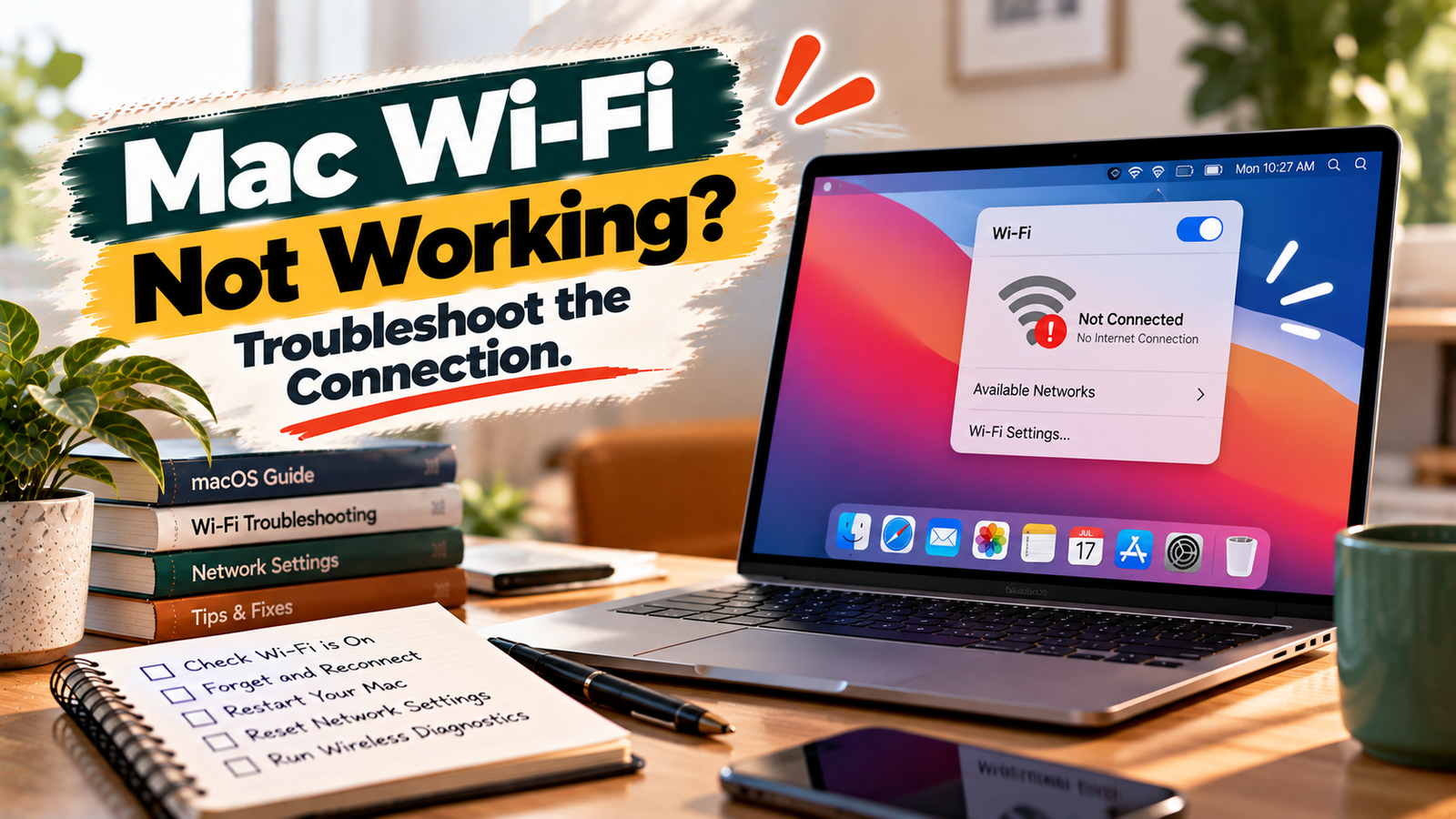
Mac Wi-Fi Not Working? Troubleshoot the Connection
When Mac Wi-Fi not working interrupts your day, the cause is not always the wireless connection itself. Your Mac might be unable to find nearby networks, fail to join a network, disconnect repeatedly, or show that it is connected while websites refuse to load.
These symptoms point to different parts of the connection. A Mac that cannot detect any Wi-Fi networks needs a different approach from one that connects successfully but cannot access the internet.
The following checks help narrow down the problem, starting with connection settings and network availability before moving to more specific diagnostics.
Quick Diagnosis: Start Here
| What you’re seeing | Start here |
|---|---|
| Wi-Fi is switched off or unavailable | Fix 1 |
| Your Mac cannot find your Wi-Fi network | Fix 2 |
| The network appears, but your Mac will not connect | Fix 3 |
| Wi-Fi connects, but websites and apps cannot access the internet | Fix 4 |
| Your Mac keeps disconnecting or loses its connection in certain places | Fix 5 |
| Wi-Fi stopped working after installing a VPN or security tool | Fix 6 |
| The connection remains unreliable after basic checks | Fix 7 |
| You need to investigate a less obvious network problem | Fix 8 |
| Wi-Fi problems persist despite the other checks | Fix 9 |
Fix 1: Check Wi-Fi and Network Availability
Before changing any settings, confirm that your Mac’s Wi-Fi service is available and switched on.
- Open the Apple menu and select System Settings.
- Select Wi-Fi in the sidebar. You may need to scroll down.
- Check whether Wi-Fi is enabled.
- If it is switched off, turn it on and wait for nearby networks to appear.
If Wi-Fi is already enabled, look at the available network list and the connection status.
If you cannot find Wi-Fi in System Settings at all, this is different from simply being disconnected. Restart your Mac and check again. If the Wi-Fi service remains missing, further investigation may be necessary.
Also check whether your Mac is in an environment where network access is restricted, such as an office, university or managed workplace. Network administrators can impose connection requirements that are not present on a typical home network.
What this tells you: If Wi-Fi becomes available and your network appears, the problem may have been a disabled connection. If the Wi-Fi service itself is missing, focus on macOS, configuration or a possible hardware issue rather than repeatedly entering your password.
Fix 2: Check Whether Your Network Is Visible
Your Mac cannot join a wireless network it cannot detect. If your home or office network is missing from the available networks list, investigate visibility, distance and the router before changing connection settings.
Try the following:
- Move closer to the router or access point.
- Open System Settings > Wi-Fi and check the available networks again.
- Confirm that the router is powered on and broadcasting its wireless network.
- Check whether another phone, tablet or computer can see the same network.
- If the network name is hidden, use the option to join another network and enter its details manually.
For a hidden network, you need the correct network name, security type and password. Entering only the password is not enough.
If other devices can see the network but your Mac cannot, check whether the router uses a frequency band or wireless configuration that is incompatible with your particular Mac. Router compatibility can vary by model and supported Wi-Fi standards.
If no devices can see the network, investigate the router or access point first.
What this tells you: A network that is invisible to every device points towards the router or its wireless settings. A network visible to other devices but not your Mac suggests a device-specific compatibility, configuration or detection problem.
Fix 3: Check the Password and Forget the Network if Needed
A network can appear in the Wi-Fi list even when your Mac cannot successfully join it. An incorrect password, outdated saved credentials or a security configuration mismatch may prevent the connection.
First, reconnect normally:
- Open System Settings > Wi-Fi.
- Select your intended network.
- Enter the current password carefully if prompted.
- Check whether the Mac completes the connection.
If you recently changed the Wi-Fi password, make sure you are not relying on the old saved credentials.
When the password is correct but the connection still fails, remove the saved network and join it again.
- Open System Settings > Wi-Fi.
- Find the network in the known or saved networks list.
- Open its details using the Details button or the corresponding options in your macOS version.
- Select Forget This Network, if available, and confirm.
- Return to the Wi-Fi list and connect again using the current password.
Forgetting a network removes its saved connection details. Make sure you know the password before doing this.
On a managed work or school network, do not remove profiles or enterprise configuration settings without checking with the administrator.
What this tells you: If reconnecting works, stale credentials or saved network configuration may have been responsible. If the Mac rejects the connection again, check the password, router security settings and any network access restrictions.
Fix 4: Find Out Whether the Internet Connection Is the Problem
A connected Wi-Fi symbol does not guarantee internet access. Your Mac may have successfully joined the router while the router itself has lost its connection to your internet provider.
This distinction can save you from changing settings unnecessarily.
Start by opening a few unrelated websites. If they all fail, try the same websites on another device connected to the same Wi-Fi network.
- Other devices also cannot access the internet: The router, modem or internet service may be responsible.
- Other devices work normally: Investigate your Mac’s network configuration or software.
- Only one website or app fails: The issue may be limited to that service rather than your Wi-Fi connection.
If possible, connect your Mac to a phone’s personal hotspot. Use this as a temporary test rather than a permanent workaround.
If the internet works through the hotspot but not through your usual Wi-Fi, the problem is more likely to involve the original network, its router settings or a compatibility issue.
You can also inspect the connection status in Apple menu > System Settings > Network > Wi-Fi. The status should indicate whether the network service is connected.
If your router and other devices have also lost internet access, restart the router and modem according to the manufacturer’s instructions. Allow them to reconnect fully before testing again.
What this tells you: When your Mac joins Wi-Fi but cannot reach the internet, the failure may lie beyond the wireless connection itself. Testing another device and another network helps separate a Mac-specific issue from a router or internet service problem.
Fix 5: Investigate Signal Strength and Wireless Interference
Does your Mac work normally near the router but disconnect when you move to another room? Or does Wi-Fi become unreliable when several devices are connected?
These patterns suggest a possible signal or wireless environment issue.
Try these checks:
- Move closer to the router and see whether the connection stabilises.
- Place the router in an open, elevated location rather than behind large furniture or inside a closed cabinet.
- Keep the router away from sources of interference where practical.
- If your router offers both 2.4 GHz and 5 GHz networks, test the available bands to see whether one provides a more stable connection in your location.
- Check whether the problem occurs in one particular room or throughout the building.
The 2.4 GHz band generally offers better reach through walls, while 5 GHz can provide higher speeds over shorter distances. Actual performance depends on the router, surrounding networks and physical environment.
Do not assume that a slow connection automatically means your Mac’s Wi-Fi hardware is failing. Congestion, distance and router placement can produce similar symptoms.
What this tells you: A connection that improves noticeably near the router points towards signal strength or interference. If the Mac disconnects even beside the router, investigate network configuration and software as well.
Fix 6: Check VPN and Network Filtering Software
VPN applications, security tools and other software that filters network traffic can sometimes interfere with internet access.
This is worth investigating if the problem started after installing a VPN, changing a security setting or updating a network-related application.
- Open the VPN or security application you use.
- Disconnect the VPN temporarily, if doing so is safe and permitted.
- Test whether websites load normally.
- If the application includes a network filter, firewall or traffic-blocking feature, review its settings.
- If the problem began immediately after installing or updating a tool, check its documentation for known connection issues.
Do not disable essential security protections permanently. If this is a managed work Mac, contact your IT administrator before changing security software or network profiles.
If disconnecting the VPN restores internet access, that is useful evidence, but it does not necessarily mean the VPN itself is defective. Its server, configuration, DNS settings or interaction with another network component could be responsible.
If disconnecting it makes no difference, restore your usual settings and continue investigating.
What this tells you: A connection that works when a VPN or network filter is temporarily inactive suggests a software-related conflict. If the problem persists, the cause may lie elsewhere.
Fix 7: Restart Your Mac and Check Network Settings
Temporary network problems can sometimes clear after a restart. Restarting may also allow macOS to establish a fresh network connection and obtain updated network configuration.
Save your work, restart the Mac normally, and test Wi-Fi again.
If the problem remains, inspect the connection details.
- Open Apple menu > System Settings > Network > Wi-Fi.
- Select the connected network and open its details.
- Review the available TCP/IP settings.
- If the connection appears to have an IP-address problem, look for the option to renew the DHCP lease under the TCP/IP settings.
- Check whether the connection works after renewing the lease.
DHCP is the mechanism commonly used by routers to assign local IP addresses to connected devices. Renewing the lease asks the network to provide updated address information.
Avoid manually changing IP addresses, DNS servers, proxies or other advanced settings without a clear reason. Incorrect values can create additional connectivity problems.
If you use custom network settings supplied by your employer, university or internet provider, record the relevant configuration and consult the administrator before modifying it.
What this tells you: If restarting or renewing the DHCP lease restores connectivity, a temporary connection or address-assignment issue may have been involved. If the network still fails, continue with diagnostics rather than resetting every network setting.
Fix 8: Run Apple’s Built-in Wireless Diagnostics
When the cause is not obvious, macOS includes a diagnostic utility that can analyse the wireless environment and help identify connection problems.
To open it:
- Hold down the Option key on your keyboard.
- While holding it, click the Wi-Fi menu in the menu bar.
- Select Open Wireless Diagnostics, if the option is available.
- Follow the instructions displayed by the utility.
You may also see Wi-Fi Recommendations in the Wi-Fi menu. If available, open it to review any suggestions macOS provides.
The exact options can vary with macOS versions and network types. Wi-Fi Recommendations is not available for every network, including certain enterprise networks and personal hotspots.
Wireless Diagnostics can help identify issues in the wireless environment, but it does not guarantee that every fault will be detected or automatically repaired.
If the utility reports a potential network issue, use the finding to guide your next step. For example, a problem involving the wireless environment warrants router and interference checks, while a broader connection failure may require investigation of network configuration or internet service.
What this tells you: Diagnostics can provide additional evidence when basic checks have not isolated the problem. Treat the results as clues rather than definitive proof that a particular component has failed.
Fix 9: Update macOS and Investigate the Router or Hardware
If Wi-Fi continues to fail after the previous checks, investigate whether the problem is related to outdated software, router compatibility or the Mac’s wireless hardware.
Check for a macOS update
If your Mac can connect through another network, use that connection to check for available macOS updates.
Open Apple menu > System Settings > General > Software Update and follow the instructions if an update is available.
Keep your Mac backed up before a major operating system upgrade. If you cannot connect to any network, do not repeatedly attempt an update through an unstable connection.
Check the router
If the problem occurs only on one Wi-Fi network, review the router’s firmware and wireless configuration using the manufacturer’s guidance.
Check whether other devices are affected and whether the router has access-control restrictions that could prevent your Mac from connecting. If you are using a workplace or public network, the administrator may need to investigate.
Consider a hardware problem
A hardware fault becomes more plausible when Wi-Fi is consistently unavailable across multiple known-working networks, the Wi-Fi service repeatedly disappears, or the problem persists after software and network causes have been investigated.
These symptoms do not prove that the wireless hardware has failed. Configuration problems and macOS issues can produce similar behaviour.
If Wi-Fi remains unavailable or unreliable across different networks, contact Apple Support or an authorised service provider for further assessment.
What this tells you: If the Mac works on other networks, focus on the original router or its configuration. If it fails across multiple networks despite appropriate software checks, device-specific troubleshooting becomes more important.
Why This Happens
Wi-Fi problems on a Mac can occur at several different stages of the connection.
First, macOS must recognise and activate the wireless service. The Mac then needs to detect a network, authenticate using the correct credentials and establish a connection with the router. Finally, that router must provide a working route to the internet.
A failure at any one of these stages can look like a general Wi-Fi problem.
For example, a missing network may indicate poor signal, a hidden network name or a router configuration issue. A password rejection points towards authentication or security settings. A connected Mac that cannot load websites may instead have a problem with IP-address assignment, DNS, VPN software or the internet service itself.
Wireless interference can cause another category of symptoms. The Mac may connect successfully but experience slow speeds or repeated disconnections because the signal is weak or the wireless environment is congested.
Software updates, security tools and managed network profiles can also change how the Mac communicates with a network.
The most reliable approach is therefore to identify the stage where the connection fails instead of repeatedly toggling Wi-Fi or resetting settings without a clear diagnosis.
How to Prevent Mac Wi-Fi Problems
You cannot prevent every network interruption, but a few habits can reduce avoidable connection issues.
- Keep macOS updated. Install appropriate updates after reviewing compatibility and backup considerations.
- Maintain your router. Keep its firmware updated and restart it when necessary, following the manufacturer’s guidance.
- Use a suitable router location. Avoid placing it behind large obstacles or in enclosed spaces where possible.
- Keep track of network credentials. When changing your Wi-Fi password, update the saved credentials on your devices.
- Review VPN and security changes. If connectivity changes after installing a network-related tool, investigate that change before modifying unrelated settings.
- Avoid unnecessary manual network changes. Incorrect IP, DNS or proxy settings can introduce problems that were not present before.
- Investigate recurring disconnections early. Note whether they occur in a particular location, on one network or after a specific software change.
If you use your Mac on multiple networks, pay attention to where the issue occurs. That information can make future troubleshooting considerably faster.
Frequently Asked Questions
Why does my Mac say it is connected to Wi-Fi but has no internet?
Your Mac may be connected to the router even though the router has lost internet access. If other devices also cannot get online, investigate the router or internet provider. If other devices work normally, check your Mac’s network configuration, VPN and security software.
Why can’t my Mac find my home Wi-Fi network?
The network may not be broadcasting, your Mac may be out of range, or the router may use an incompatible wireless configuration. Check whether other devices can see the network and move closer to the router before investigating further.
Why does my Mac keep disconnecting from Wi-Fi?
Repeated disconnections can result from weak signal strength, wireless interference, router problems, network configuration or software conflicts. Check whether the connection stabilises near the router and whether the issue occurs on other networks.
Should I reset network settings on my Mac?
Not as an initial troubleshooting step. Start with the Wi-Fi connection, router, saved credentials and relevant network settings. More extensive changes can remove saved configuration and create additional problems, particularly on managed devices.
Can a macOS update fix Wi-Fi problems?
An update may resolve a software-related issue, but it will not necessarily fix a router fault, weak signal or internet service outage. Consider updating macOS when appropriate, especially if the problem began after a software change or is addressed by a relevant update.
How can I tell whether my Mac’s Wi-Fi hardware is faulty?
A hardware issue becomes more plausible when the Wi-Fi service is consistently unavailable or the Mac fails to connect across multiple known-working networks. These symptoms are not conclusive, so seek professional assessment before replacing hardware.