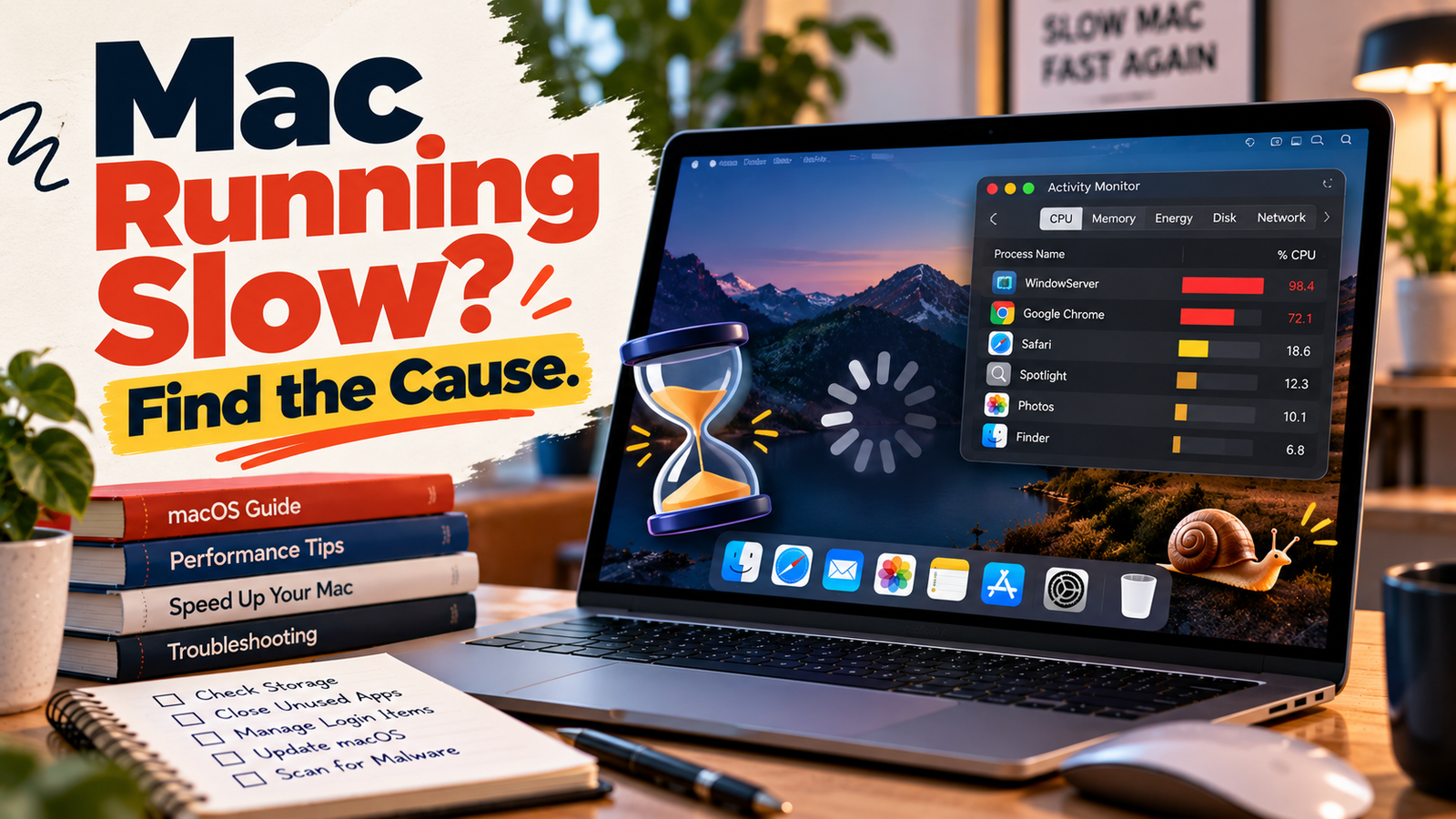
Mac Running Slow? Find the Cause
A Mac that takes longer to start, struggles to open apps or freezes during everyday tasks can be frustrating, especially when it used to run smoothly. When your Mac is running slow, the key is to identify where the slowdown occurs rather than assuming the computer is too old or needs to be reset.
Sometimes the cause is limited storage or an application consuming too many resources. In other cases, the slowdown appears after a software update, happens only when browsing the web, or points to a process running in the background.
The following checks help you narrow down the cause, starting with observable symptoms and moving towards more involved troubleshooting.
Quick Diagnosis: Start Here
| What you’re seeing | Start here |
|---|---|
| Your Mac is slow across multiple apps | Fix 1 |
| Apps take a long time to open or become unresponsive | Fix 2 |
| The Mac becomes slow when several apps are running | Fix 3 |
| Storage is nearly full | Fix 4 |
| Your Mac is slow or noisy and feels unusually warm | Fix 5 |
| The slowdown started after an update or restart | Fix 6 |
| Only your browser or websites are slow | Fix 7 |
| Your Mac remains slow after the basic checks | Fix 8 |
Fix 1: Check Whether the Slowdown Affects the Entire Mac
First, establish whether the problem is system-wide or limited to one application. This distinction helps prevent unnecessary changes to settings that may already be working correctly.
Open a few different applications, such as Finder, Safari and System Settings. Try switching between windows, opening a folder and performing a simple task in each.
Notice where the delay occurs:
- If Finder, applications and basic navigation are all slow, investigate system resources, storage and background activity.
- If only one application struggles, focus on that app rather than the entire Mac.
- If the Mac is slow only during startup or immediately after signing in, background tasks may be contributing.
- If the slowdown happens only when connected to a particular external device, disconnect it temporarily and compare performance.
Give the Mac a little time if it has just started up or completed an update. Some background tasks can temporarily increase resource use.
What this tells you: A slowdown across several unrelated applications points towards a broader system issue. A problem isolated to one app gives you a more specific place to investigate.
Fix 2: Identify Apps That Are Consuming Too Many Resources
An application that uses an unusually large amount of processing power or memory can make the rest of your Mac feel sluggish.
macOS includes Activity Monitor, which lets you inspect how applications and processes are using system resources.
- Open Finder and select Applications > Utilities > Activity Monitor. You can also search for Activity Monitor using Spotlight.
- Select the CPU tab.
- Review the processes using the most CPU resources.
- If memory pressure appears to be a concern, select the Memory tab as well.
- Look for an application that is using unusually high resources relative to what it is doing.
A demanding task, such as video editing or exporting a large file, can legitimately use substantial CPU resources. High usage alone does not establish that an application is faulty.
If an ordinary app remains unresponsive and appears to be responsible for the slowdown, save your work if possible and close it normally. If it will not respond, you can select it in Activity Monitor and use the Stop control to quit it, taking care not to terminate unfamiliar system processes.
If the same application repeatedly consumes excessive resources, check for an available update or investigate whether a particular file or task triggers the problem.
What this tells you: If performance improves after closing a resource-intensive application, you have identified a likely contributor. If no particular process stands out, continue checking memory pressure, storage and other causes.
Fix 3: Reduce the Load From Too Many Open Apps and Tabs
A Mac can become less responsive when many applications, browser tabs and background tasks compete for available memory and processing resources.
This is especially noticeable when switching between large applications, working with multiple browser windows or running demanding software alongside video calls.
Try a controlled test:
- Save your work in open applications.
- Close apps you are not using.
- Reduce the number of open browser tabs, especially those running video, interactive tools or complex web applications.
- Wait briefly for background activity to settle.
- Repeat the task that was previously slow.
Check Activity Monitor’s Memory tab if the problem continues. Memory pressure provides a more useful indication of whether available memory is becoming a constraint than simply counting how many apps are open.
You do not need to close every application after each use. The aim is to determine whether your current workload is contributing to the slowdown.
If the Mac performs well with a smaller workload but slows down consistently when several particular apps run together, review those applications’ resource requirements and settings.
What this tells you: A clear improvement after reducing the workload suggests that resource competition may be contributing. If the Mac remains slow even with a light workload, investigate storage, background tasks and software issues.
Fix 4: Check Whether Your Mac Is Running Out of Storage
A nearly full startup disk can interfere with normal macOS operations, particularly when applications need temporary working space or the system needs to manage files.
To check available storage:
- Open the Apple menu and select System Settings.
- Select General > Storage.
- Wait for macOS to calculate storage usage.
- Review which categories are consuming the most space.
- Look for files, downloads or applications you no longer need.
If storage is low, consider removing unnecessary downloads, deleting duplicate files or moving large personal files to a suitable external drive or cloud storage service.
Review large applications before uninstalling them, and make sure important files are backed up before deleting anything. Emptying the Trash can also help reclaim space after you have confirmed that its contents are no longer needed.
Do not delete system folders or unfamiliar files simply because they occupy a large amount of storage. Some files are necessary for macOS or applications to work correctly.
After freeing up space, restart the Mac if appropriate and check whether performance improves.
What this tells you: If storage was almost full and the Mac becomes more responsive after freeing space, limited disk capacity may have contributed. If plenty of space is available, look at other causes instead.
Fix 5: Investigate Excessive Heat and Background Activity
Does your Mac become unusually warm, run its fans loudly or slow down during demanding tasks? Temperature and background activity may help explain the change in performance.
Macs can reduce processing performance when thermal conditions require it. However, a warm case or audible fan does not automatically indicate a fault. Video exports, games, large downloads and other demanding tasks can increase heat and fan activity.
Check the following:
- Close demanding applications you are not using.
- Place the Mac on a hard, stable surface that allows proper ventilation.
- Make sure air vents are not obstructed.
- Open Activity Monitor and review CPU usage for processes consuming substantial resources.
- Check whether the slowdown eases after demanding tasks finish and the Mac cools.
If the problem began during a large file transfer, photo-library processing or software update, allow the task to complete if the Mac is otherwise operating normally.
If the Mac repeatedly overheats during light use, shuts down unexpectedly or remains unusually hot after demanding tasks have stopped, further investigation may be needed.
Avoid placing the Mac on soft surfaces that block ventilation, and do not attempt to cool it with ice, refrigerated objects or direct moisture.
What this tells you: If performance improves after heavy tasks finish and temperatures settle, workload or thermal conditions may have been contributing. Persistent overheating during ordinary use deserves further attention.
Fix 6: Check for Slowdowns After an Update or Restart
A Mac may temporarily feel slower after a macOS update, particularly while background tasks are completing. The timing of the slowdown can help distinguish temporary activity from a persistent problem.
If the slowdown started immediately after an update:
- Connect your Mac to power if appropriate.
- Allow ongoing setup, syncing or indexing tasks time to finish.
- Check Activity Monitor for processes using substantial CPU or disk resources.
- Restart the Mac normally if you have not already done so and no update or installation is in progress.
- Test performance again after the system has settled.
Avoid interrupting an update or repeatedly restarting the Mac while an installation is underway.
If performance remains poor after the initial post-update activity has settled, check whether your applications are compatible with the installed macOS version and whether relevant app updates are available.
If the slowdown started after installing a particular application or utility rather than macOS itself, investigate that software as a separate possibility.
What this tells you: If the Mac gradually returns to normal after background tasks finish, the slowdown may have been temporary. If the problem persists, look for a specific process, compatibility issue or other underlying cause.
Fix 7: Troubleshoot a Slow Browser or Slow Websites
If your Mac runs normally but web pages take a long time to load, the problem may not be the computer’s overall performance.
Test a few different websites. Then open another browser, if one is available, and compare the results.
- Only one website is slow: The website itself or a particular page may be responsible.
- One browser is slow but another works normally: Investigate the affected browser’s extensions, settings and cached data.
- All browsers are slow: Check the internet connection and whether other devices on the same network experience similar delays.
- The browser becomes slow with many tabs open: Reduce the workload and check resource usage.
If a particular browser is responsible, disable recently added extensions temporarily and test again. Re-enable them individually if you need to identify which one is causing the problem.
You can also try a private browsing window. If the problem disappears there, browser extensions, saved site data or other profile-specific settings may be contributing. This is a clue rather than proof of a particular cause.
Avoid clearing all browser data immediately if you rely on saved sessions or other stored information. Start with the smallest change that helps isolate the issue.
What this tells you: A Mac that performs normally outside one browser probably needs browser-specific troubleshooting. If websites are slow across browsers and devices, investigate the network or website before blaming the Mac’s hardware.
Fix 8: Investigate Persistent Slow Performance
If your Mac remains slow after checking resource usage, workload, storage, heat and recent updates, broaden the investigation.
Start by noting when the slowdown occurs. Does it happen immediately after signing in, only with a particular accessory connected, or even when no demanding apps are open?
Then consider these checks:
- Review login items: Open System Settings > General > Login Items & Extensions. Review apps that open automatically and background activity you recognise. Disable unnecessary items cautiously.
- Disconnect external accessories: Temporarily remove non-essential peripherals to see whether one of them is contributing to the problem.
- Check available updates: Review macOS and application updates, particularly if the issue began after a software change.
- Compare performance in a new user account: If practical, create a temporary test account and check whether the slowdown occurs there too. If the Mac performs normally in the new account, a setting, login item or application in the original account may be involved.
- Seek further assessment when necessary: Persistent system-wide slowness, repeated unexpected shutdowns or other unusual symptoms may require professional diagnosis.
A new user account test does not prove that the original account is damaged. It simply helps determine whether the issue may be associated with account-specific settings or software.
Do not jump straight to erasing the Mac, reinstalling macOS or deleting your user profile. Those steps are disruptive and should not be first-line responses to an unexplained slowdown.
What this tells you: If disabling an unnecessary login item or testing another account improves performance, investigate the relevant software or account settings. If the entire system remains slow, further software or hardware diagnosis may be appropriate.
Why This Happens
A Mac can become slow for several reasons, and similar symptoms do not always share the same cause.
Applications compete for processing power and memory. When one process consumes unusually high resources or several demanding applications run together, switching between tasks can become less responsive.
Storage also matters. A nearly full startup disk can leave macOS and applications with less room for temporary files and routine operations. Background activity after an update, during syncing or while processing large libraries can create another temporary source of resource demand.
Heat can affect performance too. Under demanding workloads or unfavourable thermal conditions, the Mac may limit performance to manage temperature.
Finally, a slow browser or a single unresponsive application may have little to do with the rest of the system. Browser extensions, website problems, application bugs and network delays can all create the impression that the entire Mac is struggling.
The most useful diagnostic clue is the scope of the slowdown. If it affects everything, investigate system resources and storage. If it occurs only in one app, focus on that app. If it follows a particular task, update or accessory, investigate that connection before making broad system changes.
How to Prevent Your Mac From Running Slowly
A few practical habits can help keep everyday performance consistent.
- Maintain adequate free storage. Review the Storage section periodically and remove files you no longer need.
- Watch resource-intensive apps. If an application repeatedly consumes excessive CPU or memory, investigate its settings and updates.
- Manage startup items. Keep login items limited to applications you genuinely need to open automatically.
- Keep software appropriately updated. Install relevant macOS and application updates, with backups before major upgrades.
- Allow background tasks to finish. Large transfers, syncing and post-update processing can temporarily affect responsiveness.
- Keep ventilation unobstructed. Use the Mac on a suitable surface and avoid blocking its vents.
- Investigate recurring slowdowns early. Record whether the problem affects the entire system or appears only with a particular application or task.
You do not need to install a third-party cleaning utility simply because your Mac feels slow. Begin with macOS’s built-in storage and resource tools so you can identify the problem before deciding whether additional software is necessary.
Frequently Asked Questions
Why is my Mac suddenly running slow?
A sudden slowdown can be caused by a resource-intensive application, limited storage, background processing, heat or a recent software change. Check whether the problem affects all applications and use Activity Monitor to investigate resource usage.
Can a nearly full Mac slow down?
Yes. Limited free space on the startup disk can interfere with normal system and application operations. Review System Settings > General > Storage and safely remove or move files you no longer need.
Does restarting a Mac make it faster?
Restarting can clear some temporary problems and stop processes that are no longer responding. It will not necessarily resolve persistent causes such as limited storage, an application bug or hardware trouble.
Why is my Mac slow after a macOS update?
Some background tasks may continue after an update, temporarily increasing resource use. Allow the system time to settle, then investigate persistent slowdowns through Activity Monitor and application compatibility checks.
How do I know whether an app is slowing down my Mac?
Open Activity Monitor and review CPU usage and memory pressure. If performance improves after you close a particular resource-intensive application, investigate that app and the tasks it performs.
Should I factory-reset my Mac if it is slow?
No, not as an initial troubleshooting step. Check storage, resource usage, login items and application-specific problems first. Erasing the Mac is disruptive and should be considered only after less invasive options have been assessed and important data has been backed up.