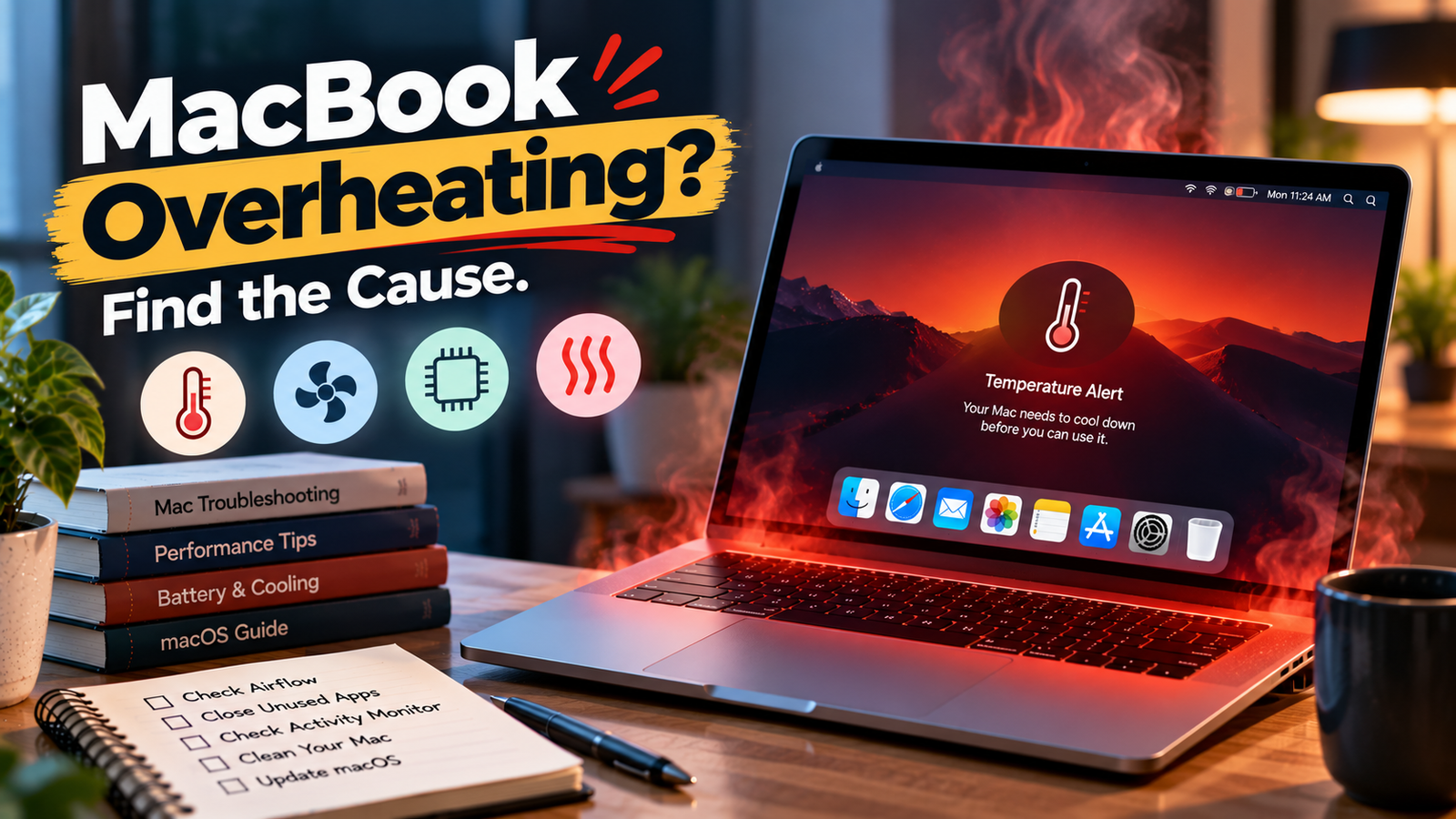
MacBook Overheating? Find the Cause
Is your MacBook getting unusually hot, even when you’re doing something as simple as browsing the web? A warm MacBook is not necessarily a sign of trouble. Demanding applications, background processes, charging, and warm surroundings can all increase its temperature. However, if your MacBook becomes uncomfortably hot, its fans run constantly, or performance drops noticeably, it is worth investigating.
The important thing is to distinguish normal heat from a recurring problem. A MacBook that gets warm during video editing may be behaving as expected, while one that overheats during light use could have a software, ventilation, battery, or hardware issue.
Use the checks below to identify what may be causing the heat before trying more advanced fixes.
Quick Diagnosis: Start Here
Quick Diagnosis: Start Here
| What you’re seeing | Start here |
|---|---|
| Your MacBook gets hot during everyday tasks | Go to Fix 1 ↗ |
| The fans are running constantly or loudly | Go to Fix 2 ↗ |
| Your MacBook heats up after opening a particular app | Go to Fix 3 ↗ |
| Your MacBook gets hot while charging | Go to Fix 4 ↗ |
| The laptop gets hot on a bed, cushion, or soft surface | Go to Fix 5 ↗ |
| Your MacBook overheats after a macOS update | Go to Fix 6 ↗ |
| Your MacBook is hot and running slowly | Go to Fix 7 ↗ |
| The MacBook remains unusually hot despite these checks | Go to Fix 8 ↗ |
Fix 1: Check What Your MacBook Is Doing
Before changing settings, look at what is happening when the MacBook gets hot.
Temperature can rise during video editing, gaming, large file transfers, video calls, software development, and other demanding tasks. Your MacBook may also become warmer while performing background work.
Start with these steps:
- Save your work and close applications you are not using.
- Pause demanding tasks temporarily.
- Give your MacBook several minutes to cool down.
- Check whether the temperature begins to settle.
- Notice whether the heat returns during light tasks, such as browsing or reading documents.
If the MacBook cools down after a demanding task finishes, the temperature increase may be normal.
If it remains unusually hot while idle or performing simple tasks, investigate background processes and individual applications.
Do not rely on how hot the case feels alone to determine whether the MacBook is overheating. The location of the heat, fan behaviour, performance, and whether the temperature settles after a workload ends are all useful clues.
Fix 2: Investigate Constant or Loud Fan Activity
If your MacBook has fans that run loudly for long periods, a process may be using substantial processing power. High fan activity can also occur during demanding work or when the computer is operating in a warm environment.
To investigate:
- Open Activity Monitor using Spotlight Search.
- Select the CPU tab.
- Sort the list by the % CPU column.
- Look for applications or processes consuming unusually high processing power.
- If an application you recognise is using excessive resources unnecessarily, save your work and close it.
Some macOS processes may use more CPU temporarily while indexing files, processing photos, or completing background tasks. Avoid terminating unfamiliar system processes just because they appear near the top of the list.
If one application repeatedly consumes substantial CPU resources without a clear reason, check for an update or consult the developer’s support information.
If fan activity remains unusually high even after resource-intensive tasks have ended, continue with the other checks.
Fix 3: Identify Applications That Make Your MacBook Hot
Sometimes the problem begins after opening a particular application. A browser with many active tabs, a video editing tool, a game, or an application running an intensive background task can increase processor and graphics activity.
Try this diagnostic approach:
- Note which applications are open when the MacBook becomes hot.
- Close one demanding application at a time.
- Observe whether the temperature and fan activity begin to settle.
- Reopen the application and see whether the problem returns.
- Check for application updates if the behaviour is repeatable.
If the heat consistently returns when you open a specific application, the software may be responsible. It could also be performing a legitimate but demanding task, so consider what the application is doing before assuming it is malfunctioning.
For browser-related heat, close unnecessary tabs and temporarily disable extensions you do not need. If the problem persists, test whether it occurs in another browser.
Avoid installing third-party temperature or fan-control utilities unless you have a specific reason to use them. Built-in macOS tools are a sensible starting point.
Fix 4: Check Whether Charging Is Contributing to the Heat
A MacBook may become warmer while charging, especially when you are simultaneously running demanding applications. However, excessive or persistent heat should not be ignored.
Try these checks:
- Use a compatible charger and cable that meet your MacBook’s power requirements.
- Place the MacBook on a hard, flat surface.
- Close applications performing heavy processing.
- Allow the device to cool if it becomes unusually warm.
- Check whether the heat settles when charging finishes or the workload decreases.
If the MacBook heats up only when using a particular adapter or cable, inspect that equipment for visible damage and test a known-good compatible alternative if available.
Stop using damaged charging equipment. If you notice a burning smell, battery swelling, or abnormal heat around the charging port, disconnect power if it is safe to do so and seek professional assistance.
A MacBook that remains excessively hot during ordinary charging may need further evaluation.
Fix 5: Improve Ventilation and Your Working Environment
Where you place your MacBook can affect how effectively it manages heat.
Using it on a bed, blanket, cushion, or other soft surface can obstruct ventilation or trap heat around the computer. Direct sunlight and warm rooms can also make it harder for the MacBook to cool down.
Try the following:
- Move your MacBook to a hard, flat surface.
- Keep its ventilation areas unobstructed.
- Move it away from direct sunlight and other heat sources.
- Disconnect accessories you do not need.
- Allow the computer to cool before returning to demanding work.
Avoid covering the MacBook or placing it in a confined space while it is running.
Do not attempt to cool it rapidly with ice, a refrigerator, or other extreme methods. Sudden temperature changes and condensation can damage electronic components.
If the MacBook continues to overheat in a comfortable room with adequate ventilation, the environment may not be the primary cause.
Fix 6: Check for Background Activity After a macOS Update
A MacBook may become warmer than usual after a macOS update because the system is completing background tasks. Depending on what needs to be processed, this can include indexing files, analysing photos, or other maintenance activities.
If the heat began immediately after an update:
- Connect your MacBook to a suitable power source if needed.
- Keep it on a hard, well-ventilated surface.
- Close unnecessary applications.
- Allow background tasks time to finish.
- Check whether the temperature and fan activity settle later.
If the problem continues, open Activity Monitor and look for processes consuming substantial CPU resources.
Also check whether the applications you use regularly have updates available that address compatibility problems with your macOS version.
Do not repeatedly interrupt background work or reinstall macOS simply because the MacBook is temporarily warmer after an update. If excessive heat persists or the system becomes unstable, investigate further.
Fix 7: Address Heat Accompanied by Slow Performance
If your MacBook is both hot and unusually slow, it may be reducing performance to manage its temperature. High processor usage, insufficient available memory, demanding applications, or another system problem may also contribute to both symptoms.
Start with these checks:
- Close applications you do not need.
- Open Activity Monitor and check CPU usage.
- Review memory pressure in the Memory tab.
- Check available storage under System Settings → General → Storage.
- Restart your MacBook if the system remains unresponsive after you have saved your work.
If one application is responsible for sustained high resource usage, update it or investigate its settings.
If the MacBook is hot and slow even when no demanding applications are running, do not assume that clearing storage alone will fix the issue. Persistent performance problems can have several causes, including software conflicts and hardware faults.
If the problem began after installing new software, check whether that software is running in the background or loading automatically at startup.
Fix 8: Check for Persistent Hardware or Cooling Problems
If your MacBook remains unusually hot after you have reduced its workload, improved ventilation, and checked background activity, further diagnosis may be necessary.
Consider these possibilities:
- A fan or cooling component may not be functioning correctly on models that use active cooling.
- Dust or internal obstructions may be affecting heat dissipation.
- A battery or charging component may be developing a fault.
- A software problem may be causing sustained background activity.
- An internal hardware issue may be affecting normal operation.
You can restart your MacBook and check whether the problem returns during light use. If the same behaviour continues, consider running Apple Diagnostics to check for certain hardware issues.
The steps for Apple Diagnostics depend on whether your MacBook has Apple silicon or an Intel processor. Follow Apple’s instructions for your model.
A diagnostic test may not detect every fault, so a normal result does not rule out all hardware problems.
If the MacBook repeatedly becomes excessively hot, shuts down unexpectedly, or shows signs of battery swelling, stop using it and seek qualified service. Do not open the computer or attempt internal repairs unless you are properly equipped and qualified.
Why MacBooks Overheat
MacBooks generate heat as their processors, graphics hardware, battery, and other components operate. Their thermal management systems regulate performance and, on supported models, use fans to help dissipate heat.
Common reasons for excessive or persistent heat include:
- Demanding applications: Video editing, gaming, large computations, and other intensive tasks can increase processor and graphics activity.
- Background processes: Indexing, updates, and other maintenance tasks may temporarily increase resource usage.
- Software problems: An application may become stuck or consume more processing power than expected.
- Restricted ventilation: Soft surfaces, confined spaces, or warm surroundings can make heat dissipation less effective.
- Charging and workload: Charging alongside demanding work can increase the heat generated by the computer.
- Cooling or hardware faults: A failing component may prevent the MacBook from managing temperature normally.
The pattern matters. Heat during intensive work that settles afterward is different from persistent overheating during light use or while idle.
How to Prevent MacBook Overheating
A few everyday habits can help your MacBook manage heat more effectively.
- Use a hard, flat surface: Avoid blocking ventilation or trapping heat under the computer.
- Close unnecessary applications: Reduce avoidable background processing.
- Keep software updated: Install appropriate macOS and application updates.
- Monitor resource usage: Use Activity Monitor when the fans run constantly or performance drops.
- Use compatible charging equipment: Avoid damaged or unsuitable adapters and cables.
- Avoid excessive ambient heat: Keep the MacBook away from direct sunlight and poorly ventilated spaces.
- Allow demanding tasks to finish: Some temporary heat is expected during intensive workloads.
- Investigate recurring symptoms: Repeated overheating, unexpected shutdowns, or battery changes deserve attention.
Frequently Asked Questions
Is it normal for a MacBook to get hot?
Yes. MacBooks can become warm during demanding tasks, charging, and background processing. The concern is persistent or excessive heat, particularly when the computer is idle, repeatedly shuts down, or shows other unusual symptoms.
Why is my MacBook overheating when nothing is open?
Background processes may still be running even when no applications are visible. Open Activity Monitor and check CPU usage. If the MacBook continues to run unusually hot while idle, investigate recent software changes or seek technical support.
Why are my MacBook fans constantly running?
High CPU usage, demanding applications, background tasks, and warm surroundings can cause increased fan activity. Check Activity Monitor and improve ventilation. If the fans remain loud during light use, further investigation may be needed.
Can charging make my MacBook overheat?
Charging can contribute to heat, particularly when the MacBook is also performing demanding tasks. Use a compatible charger, keep the computer ventilated, and investigate persistent or abnormal heat during charging.
Should I shut down my MacBook if it gets too hot?
If it becomes unusually hot, save your work and allow it to cool. If it is extremely hot, shuts down unexpectedly, or shows signs of battery swelling or physical damage, stop using it and seek professional assistance.
Can overheating damage a MacBook?
Repeated excessive heat can put additional stress on components and may cause the system to reduce performance or shut down for protection. Address recurring overheating rather than relying on these protective measures as a permanent solution.