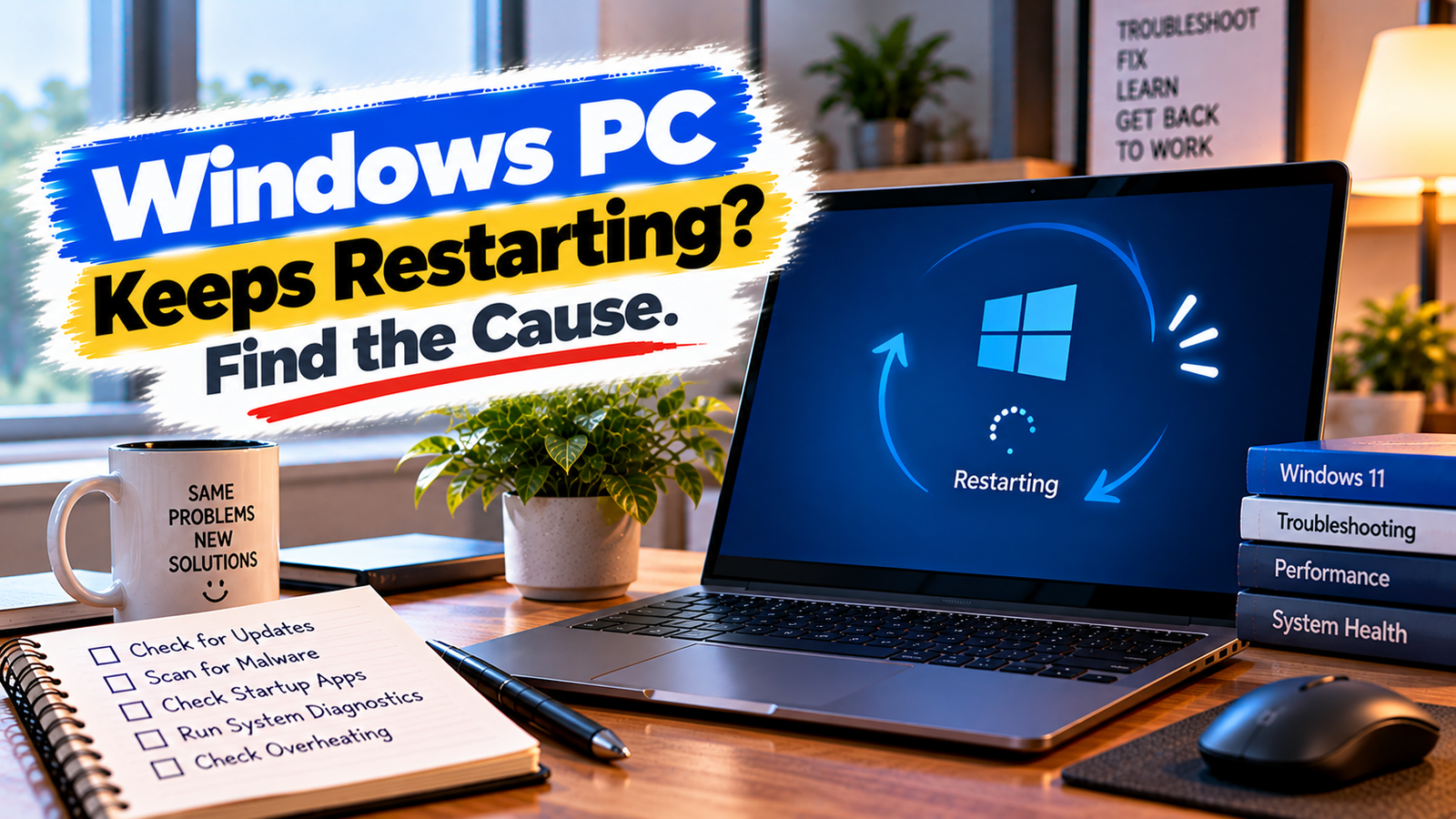
Windows PC Keeps Restarting? Find the Cause
A Windows PC that restarts without warning can interrupt your work, close unsaved files and leave you wondering whether the problem is temporary or something more serious. Sometimes the computer reboots during startup; in other cases, it runs for a while before restarting unexpectedly.
The timing is often the best clue. A restart during gaming points toward different possibilities than one that begins immediately after a Windows update. Identifying the pattern first can help you avoid trying fixes that have little to do with the actual problem.
Quick Diagnosis: Windows PC Keeps Restarting?
| What you’re seeing | Start here |
|---|---|
| The PC restarted unexpectedly, but only once | Go to Fix 1 |
| Windows keeps restarting during startup | Go to Fix 2 |
| The PC restarts during gaming or heavy use | Go to Fix 3 |
| Restarts began after an update or driver change | Go to Fix 4 |
| A blue screen appears before the PC restarts | Go to Fix 5 |
| Restarts continue without an obvious trigger | Go to Fix 6 |
Fix 1: Check Whether It Was a One-Time Restart
If your PC restarted unexpectedly only once, look at what was happening immediately beforehand.
Was Windows installing an update? Had you connected new hardware, launched a demanding application or experienced a power interruption?
Check Settings → Windows Update → Update history to see whether an update was installed around that time.
If the computer is now running normally, monitor it before changing several settings at once. A single restart doesn’t necessarily indicate a persistent fault.
However, repeated restarts, unusual heat, strange noises or signs of electrical damage deserve closer attention.
Fix 2: Investigate a Restart Loop During Startup
A PC that keeps restarting before you can reach the desktop requires a different approach from one that reboots occasionally during normal use.
Start by disconnecting nonessential USB devices and accessories. Leave the necessary peripherals connected, then try starting Windows again.
If the computer reaches the desktop, reconnect the devices individually. This can help identify whether a peripheral or its driver is contributing to the problem.
If Windows still restarts before you can sign in, you may need to use the Windows Recovery Environment. Depending on how far startup progresses, you may be able to access it through an automatic recovery screen or Windows installation media.
From there, try Startup Repair. If the restart loop began immediately after a Windows update, recovery options may also allow you to uninstall that update.
Avoid resetting or reinstalling Windows before exploring less disruptive recovery options.
Fix 3: Check for Overheating or Power Problems
Does the PC restart when you’re gaming, editing video or running another demanding application? If so, heat and power delivery are worth investigating.
For a desktop, check that the ventilation openings are clear and the fans are working. For a laptop, use it on a hard, flat surface and ensure its vents aren’t blocked.
Also consider whether the problem began after adding hardware or replacing components.
A failing or inadequate desktop power supply can cause instability under load. On a laptop, the battery, power adapter or internal cooling system may be involved.
If the computer becomes unusually hot or repeatedly shuts down during demanding tasks, stop stressing the system until the cause is understood. Don’t open a power supply or attempt electrical repairs yourself.
Fix 4: Review Recent Windows Updates and Driver Changes
If the restarts started after a Windows update, driver installation or hardware change, investigate that connection first.
Open Settings → Windows Update → Update history and review recently installed updates.
If you suspect a specific driver, open Device Manager, locate the relevant device and check its driver properties. A Roll Back Driver option may be available if Windows retains the previous version.
Use it when the timing supports a connection between the driver change and the restart problem.
You should also check for pending Windows updates. Some updates require a planned restart to finish installing, but repeated unexpected reboots should not automatically be treated as normal update behaviour.
Fix 5: Look for Clues in Blue Screen Errors
If a blue screen appears before the PC restarts, the error message can help narrow down the cause.
Write down the stop code or take a photo of the screen. Even a partial error message may be useful.
Possible areas to investigate include:
- Recently installed drivers
- Newly connected hardware
- Memory-related problems
- Damaged Windows system files
- Storage or other hardware faults
If the blue screen disappears too quickly, review the Startup and Recovery settings. Windows may be configured to restart automatically after a system failure, preventing you from reading the error.
Don’t assume every blue screen has the same cause. The stop code, recent changes and frequency of the crashes all matter.
Fix 6: Check Windows Reliability History and System Logs
When the PC keeps restarting without an obvious trigger, Windows’ diagnostic records can help establish what happened.
Search for View reliability history from the Start menu and open Reliability Monitor.
Look for critical events around the time of each restart. These may reveal Windows failures, application crashes or hardware-related problems.
You can also open Event Viewer and navigate to:
Windows Logs → System
Review events recorded immediately before the unexpected restart.
One event you may encounter is Kernel-Power, Event ID 41. This indicates that Windows detected an unclean shutdown; it does not, by itself, prove that the power supply is faulty. Power loss, a system crash or a forced shutdown can all produce this record.
If the logs repeatedly suggest a hardware fault, memory problem or storage issue, further testing may be necessary.
Why This Happens
Unexpected restarts are symptoms rather than a diagnosis. The computer may be responding to a system crash, overheating, unstable power delivery, a driver problem or a hardware fault. Sometimes Windows is simply completing a planned update.
The pattern helps narrow the possibilities:
- During startup: Windows recovery, startup files, drivers or hardware may be involved.
- Under heavy workloads: Temperature, power delivery or component stability deserve attention.
- After an update: A driver or software change may be responsible.
- With a blue screen: The stop code provides a starting point.
- At seemingly random times: Reliability History, Event Viewer and hardware checks can help narrow the investigation.
How to Reduce Unexpected Restarts
A few habits can help you catch problems before they cause repeated interruptions.
- Keep Windows and device drivers updated using reliable sources.
- Maintain clear ventilation around the PC.
- Back up important files regularly.
- Record blue-screen stop codes instead of dismissing them.
- Pay attention to restarts that begin after installing hardware or software.
- Investigate recurring shutdowns rather than repeatedly forcing the computer to restart.
Frequently Asked Questions
Why does my Windows PC restart without warning?
Possible causes include a system crash, overheating, power problems, faulty drivers or hardware issues. Check when the restart happens and review Windows’ diagnostic records to narrow down the cause.
Why does my PC keep restarting before Windows loads?
Repeated startup restarts may be related to Windows startup problems, a recent update, a driver or hardware instability. Disconnect nonessential peripherals and consider Windows recovery tools if you cannot reach the desktop.
Can overheating cause a computer to restart?
Yes. Excessive heat can cause instability or trigger protective shutdown behaviour. Check ventilation and cooling, particularly if restarts happen during demanding tasks.
What does Kernel-Power Event ID 41 mean?
It means Windows detected that the previous shutdown was not clean. It is evidence of an unexpected shutdown, not proof that the power supply is faulty.
Why does my PC restart while gaming?
Gaming places additional demands on the processor, graphics card and power system. Heat, power delivery, driver instability and hardware faults are all worth investigating if restarts happen specifically under load.
Should I reinstall Windows if my PC keeps restarting?
Not as a first step. Investigate recent changes, blue-screen errors, overheating, power issues and system logs before considering major recovery options. Reinstalling Windows will not fix a failing power supply or other physical hardware fault.